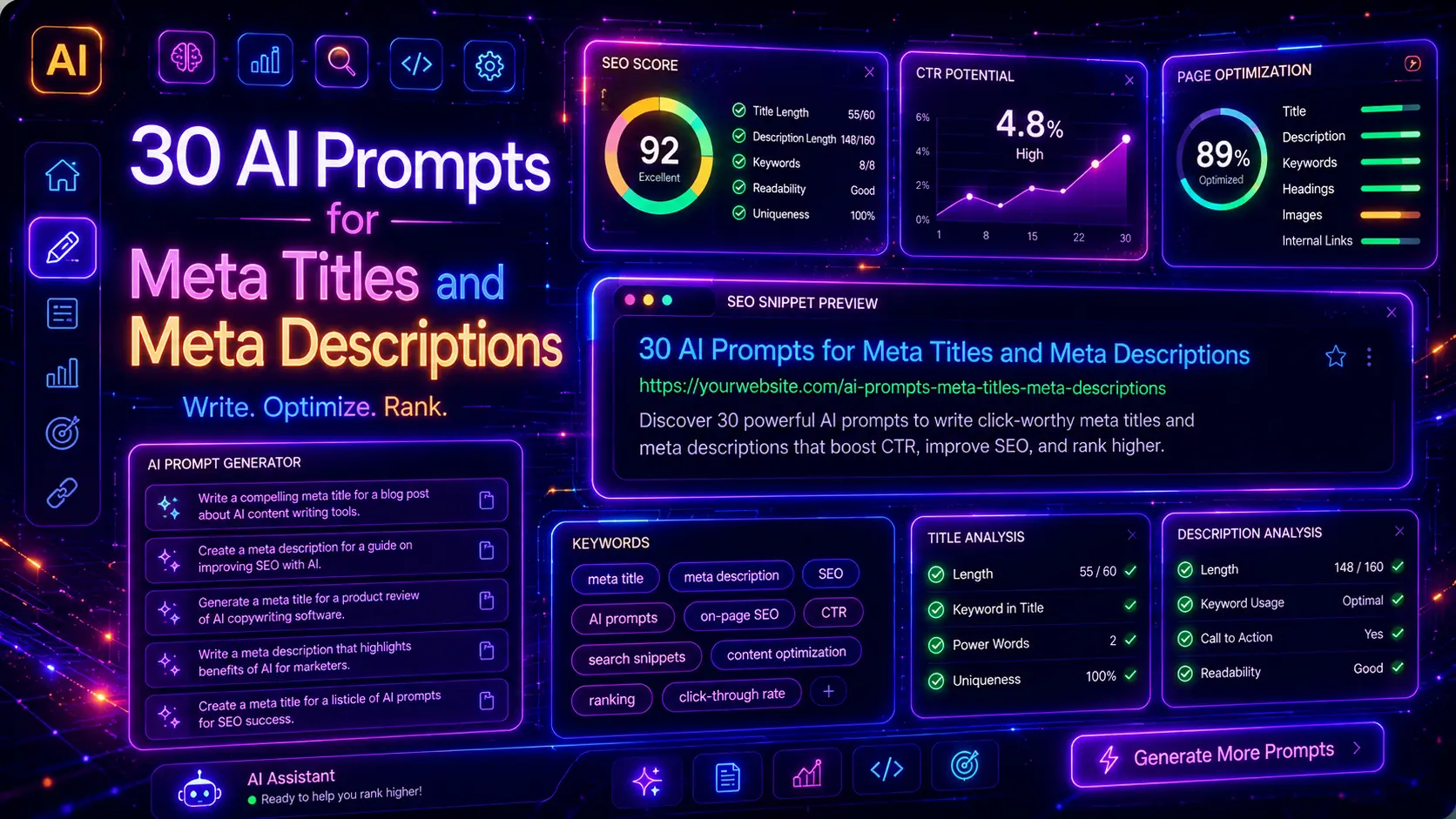
Meta titles and meta descriptions are small SEO elements, but they can have a big impact on how your pages appear in search results. A good SEO snippet helps searchers understand what the page offers, why it matches their intent, and why they should click your result instead of another one.
This guide gives you 30 professional AI prompts for meta titles and meta descriptions. These prompts are built for real SEO workflows: writing SEO titles, improving click-through rate, matching search intent, creating meta descriptions for blog posts, landing pages, ecommerce pages, service pages, local SEO pages, WordPress posts, and refreshing old snippets that are too long, too generic, or not aligned with the page content.
This post focuses only on SEO snippets and page-level optimization. It does not replace keyword research or full content writing. For those parts of the workflow, use our related guides: ChatGPT prompts for SEO content writing, ChatGPT prompts for keyword research, AI prompts for website copywriting, and ChatGPT prompts for WordPress websites.
What Are AI Prompts for Meta Titles and Descriptions?
AI prompts for meta titles and meta descriptions are structured instructions that help tools like ChatGPT create better search snippets. Instead of asking AI to “write a meta description,” a professional prompt gives it the page type, target keyword, search intent, audience, value proposition, character or pixel limits, and the reason someone should click.
A strong SEO snippet does two jobs. First, it helps search engines and searchers understand what the page is about. Second, it helps the searcher decide whether your result is the best match for their problem. That means meta titles and descriptions should be clear, relevant, specific, and aligned with the page content.
These prompts are useful for SEO writers, WordPress site owners, bloggers, agencies, ecommerce stores, SaaS teams, local businesses, affiliate websites, and anyone who needs to improve page snippets without writing generic titles and descriptions manually for every URL.
Why SEO Snippet Prompts Matter
SEO snippet prompts matter because a weak title or description can reduce clicks even when the page has good content. If the snippet is too long, too vague, keyword-stuffed, or not aligned with search intent, users may skip it and choose another result.
- They improve clarity: AI can turn broad page content into a focused search result preview.
- They help match search intent: A blog post, product page, service page, and landing page need different snippet angles.
- They support CTR: Better titles and descriptions can make your result more attractive without using clickbait.
- They save time: AI can create multiple snippet variations for testing and editing.
- They reduce generic SEO text: Specific prompts produce better titles than “Best Guide 2026” style outputs.
How to Use These Meta Title and Description Prompts
Each prompt below is copy-paste ready. Replace the bracketed parts such as [page topic], [primary keyword], [search intent], [audience], [page URL], and [page content]. Use the output as a draft, then edit it manually so it fits your brand, page content, and SEO plugin limits.
Use these prompts after keyword research and before publishing the page. If you are still choosing keywords, start with ChatGPT prompts for keyword research. If you need the full article or page content first, use ChatGPT prompts for SEO content writing.
What Should a Good Meta Prompt Include?
30 AI Prompts for Meta Titles and Meta Descriptions
Below are 30 professional AI prompts for meta titles and meta descriptions. Each prompt is built for one specific SEO snippet task, from writing titles for new posts to improving old descriptions, creating ecommerce snippets, and checking whether your SEO title is too long or too vague.
1. SEO Meta Title and Description Prompt
This prompt creates a complete SEO title and meta description for any page. It is best used after the page content and primary keyword are already clear.
How to customize it: Add your real page promise. This helps AI write a snippet that is not only keyword-focused, but also click-worthy.
2. Blog Post Meta Snippet Prompt
This prompt is designed for blog posts and informational articles. It helps create snippets that describe the article clearly and promise useful value.
Why it works: It gives several snippet angles, so you can choose between safe, concise, and stronger CTR-focused versions.
3. Search Intent Meta Description Prompt
This prompt focuses on matching the snippet to the reason people are searching. It is useful when your title is good but your description feels generic.
How to use it: Use this when you know the keyword but need the snippet to better match what the searcher actually wants.
4. CTR Improvement Prompt
This prompt improves existing snippets that are ranking but not getting enough clicks.
Why it works: It focuses on improving an existing snippet instead of writing from scratch, which is useful for pages already getting impressions.
5. Short SEO Title Prompt
This prompt creates shorter SEO titles that avoid being cut off in Google results or SEO plugins.
How to customize it: Paste your current title from your SEO plugin. This is especially useful when the title is too wide in pixels.
6. Meta Description Shortening Prompt
This prompt shortens long meta descriptions while keeping the strongest value and main keyword.
Why it works: It keeps the snippet focused and prevents the description from becoming a cut-off first paragraph.
Need better SEO snippets for your WordPress pages?
If your titles and meta descriptions are too long, too generic, or not connected to search intent, we can help optimize your WordPress pages, blog posts, service pages, and product snippets.
Contact Us7. WordPress SEO Snippet Prompt
This prompt is built for WordPress posts and pages where you need SEO plugin-ready titles and descriptions.
How to use it: This works well with SEO plugins when you need the title, description, keywords, and social snippet in one workflow.
8. Ecommerce Product Meta Prompt
This prompt creates snippets for ecommerce product pages, where the searcher may already be close to buying.
Why it works: Product snippets need to show relevance and buyer value without sounding like spam.
9. Ecommerce Category Meta Prompt
This prompt helps write snippets for product category pages, where users are comparing multiple products or browsing options.
How to use it: Use this for WooCommerce categories, Shopify collections, and ecommerce archive pages.
10. Service Page Meta Prompt
This prompt creates snippets for service pages where the goal is usually lead generation or quote requests.
Why it works: Service snippets must be clear, local where needed, and focused on trust and action.
11. Local SEO Meta Prompt
This prompt creates snippets for local pages where location, service, and trust matter.
How to customize it: Add real trust signals only. Do not let AI invent reviews, years of experience, or guarantees.
12. Landing Page Meta Prompt
This prompt creates snippets for landing pages where the goal is conversions, not only traffic.
Why it works: Landing page snippets need a stronger value proposition, but they must still match what the searcher expects.
Want SEO snippets that support clicks and conversions?
We can help optimize meta titles, meta descriptions, landing page snippets, service page SEO, WooCommerce snippets, and WordPress SEO settings so your pages look better in search results.
Improve My SEO Snippets13. Homepage Meta Prompt
This prompt creates homepage snippets that explain the brand, main service, and value clearly.
How to use it: Use this when your homepage title is only the brand name or when the description does not explain what the business actually does.
14. SaaS Meta Snippet Prompt
This prompt creates SEO snippets for SaaS pages, feature pages, use-case pages, and software landing pages.
Why it works: SaaS snippets need to connect features with outcomes without becoming vague or overhyped.
15. Comparison Page Meta Prompt
This prompt creates snippets for comparison pages, alternatives articles, and versus content.
How to use it: Use this for “best,” “vs,” “alternatives,” and comparison articles where readers need help choosing.
16. FAQ Page Meta Prompt
This prompt creates snippets for FAQ pages, help pages, and support content.
Why it works: FAQ snippets should be clear and useful, not just stuffed with question keywords.
17. Meta Snippet Audit Prompt
This prompt reviews existing meta titles and descriptions and explains what should be fixed.
How to use it: Use this for old posts, pages with weak CTR, or pages where your SEO plugin shows title or description length problems.
18. Bulk Meta Snippet Prompt
This prompt helps create meta titles and descriptions for multiple pages in one workflow.
Why it works: Bulk snippets can become repetitive. This prompt asks AI to keep each page specific and flag weak inputs.
Need to optimize many WordPress SEO snippets at once?
If you have many posts, products, or service pages with weak meta titles and descriptions, we can help build a clean metadata workflow and optimize them properly.
Optimize My Metadata19. Meta Title Variant Testing Prompt
This prompt creates title variants for testing different angles without changing the page topic.
How to use it: Use one variant, monitor performance, then test another later if impressions are good but clicks are weak.
20. Meta Description Value Proposition Prompt
This prompt focuses on making the description explain why the page is worth clicking.
Why it works: A meta description should not just summarize the page. It should explain why the result is useful.
21. Brand-Safe Meta Prompt
This prompt creates snippets that match a brand voice instead of sounding like generic AI SEO text.
How to customize it: Add words your brand never uses. This helps prevent snippets that feel off-brand.
22. Meta Snippet Rewrite Prompt
This prompt rewrites weak snippets while preserving the original keyword and page meaning.
Why it works: It improves existing text without changing the target of the page.
23. Meta Snippet From Full Content Prompt
This prompt creates snippets by analyzing the full page content instead of only a title or topic.
How to use it: This is one of the safest prompts because it asks AI to read the page before writing the snippet.
24. Search Console Snippet Improvement Prompt
This prompt uses Search Console performance data to improve snippets for pages with impressions but weak CTR.
Why it works: It uses real query data instead of guessing what people search for.
Want better CTR from existing Google impressions?
If your pages already get impressions but not enough clicks, we can help audit Search Console data, improve snippets, update content, and strengthen internal links.
Improve My CTR25. Social Meta Title and Description Prompt
This prompt creates social titles and descriptions for Facebook, LinkedIn, X, and other share previews.
How to use it: SEO title and social title do not need to be identical. Social snippets can be more conversational.
26. Image SEO Text Prompt
This prompt creates image alt text and image title text that supports the page topic without stuffing keywords.
Why it works: Good alt text should describe the image first and support SEO naturally, not act like a keyword dump.
27. Meta Keywords and Tag Prompt
This prompt helps create focus keywords, secondary keywords, and WordPress tags that match the page instead of random broad terms.
How to use it: Use this after keyword research. Do not use tags as random keyword stuffing.
28. Duplicate Meta Description Check Prompt
This prompt checks whether multiple pages have snippets that are too similar and need to be rewritten.
Why it works: Large sites often end up with repetitive snippets. This prompt helps make each page distinct.
29. Final SEO Snippet Review Prompt
This prompt reviews the final snippet before publishing and checks for common problems.
How to use it: Use this as a final check before saving SEO plugin settings.
30. Complete Meta Optimization Workflow Prompt
This prompt creates a complete repeatable workflow for optimizing meta titles, descriptions, social snippets, image SEO, and keyword fields.
Why it works: It turns metadata writing into a repeatable SEO workflow instead of a last-minute field you fill randomly.
Need help building a full SEO metadata workflow?
If you want better meta titles, meta descriptions, social previews, image SEO text, and WordPress SEO settings, we can help build a clean workflow for your site.
Contact UsMeta Title and Description Best Practices
Meta titles and descriptions work best when they are written for both search intent and human decision-making. The title should clearly show the topic and keyword focus. The description should explain what the reader will get from the page and why the result is worth clicking.
- Keep SEO titles concise: Shorter titles are less likely to be cut off and are easier to understand.
- Use the main keyword naturally: Place it near the beginning if possible, but do not force it.
- Write for search intent: A tutorial page, product page, and service page need different snippet angles.
- Make descriptions useful: Do not simply copy the first sentence of the post.
- Avoid duplicate snippets: Every important page should have a unique title and description.
- Do not overpromise: The snippet must match what the page actually provides.
- Review snippets after publishing: Use Search Console data to improve pages with impressions but weak CTR.
Common Meta Title and Description Mistakes
The most common mistake is using a page title or first paragraph as the SEO snippet without editing it. This often creates titles that are too long and descriptions that do not explain the page value clearly enough.
- SEO title too long: Long titles may be cut off and lose the strongest words.
- Description too generic: Descriptions like “learn more about this topic” do not create a strong reason to click.
- Keyword stuffing: Repeating the keyword makes the snippet look unnatural.
- Wrong intent: A commercial keyword with an informational snippet can reduce clicks.
- Duplicate metadata: Similar descriptions across many pages reduce clarity and uniqueness.
- Unsupported claims: Do not promise “best,” “cheapest,” “guaranteed,” or “fastest” unless the page proves it.
AI Meta Title and Description FAQ
Can AI write good meta titles and meta descriptions?
Yes, AI can help create good meta titles and descriptions when the prompt includes the page topic, primary keyword, search intent, audience, page type, and real page summary. Human review is still important before publishing.
What is the best AI prompt for meta descriptions?
The best prompt asks AI to match the meta description to the search intent, keep it concise, use the main keyword naturally, explain the page value, and avoid unsupported claims or clickbait.
Should the SEO title be the same as the H1?
Not always. The H1 can be longer and more descriptive, while the SEO title should usually be shorter and optimized for how the page appears in search results.
How long should a meta description be?
A practical target is usually around 145-155 characters, but clarity matters more than exact character count. Search engines may also rewrite descriptions depending on the query.
Can a better meta description improve rankings?
A meta description is not usually a direct ranking factor, but a clearer and more relevant snippet can improve click-through rate, user expectations, and search result performance.
Should every page have a unique meta description?
Yes, important pages should have unique meta descriptions that match their specific topic, search intent, and value. Duplicate snippets make pages harder to distinguish in search results.
Conclusion
AI can make meta title and meta description writing faster, but the best results come from clear prompts and careful human review. A strong prompt tells AI the page type, primary keyword, search intent, audience, page promise, and tone. That helps create snippets that are clear, useful, accurate, and more likely to attract the right clicks.
Use these 30 AI prompts as a practical workflow for SEO snippets. Start with keyword and intent confirmation, create title and description options, check length, improve click value, write social snippets, add image SEO text, and review everything before publishing. For the full content workflow, connect this guide with ChatGPT prompts for SEO content writing and ChatGPT prompts for keyword research.
Related AI, SEO and Content Guides
- 30 ChatGPT Prompts for SEO Content Writing
- 30 ChatGPT Prompts for Keyword Research
- 30 AI Prompts for Social Media Posts
- 30 AI Prompts for Ecommerce Product Descriptions
- 30 ChatGPT Prompts for WordPress Websites
- 30 AI Prompts for Website Copywriting
- 30 AI Prompts for Landing Pages
- JavaScript Search Filter Examples
- Modern CSS Form Examples
Image SEO
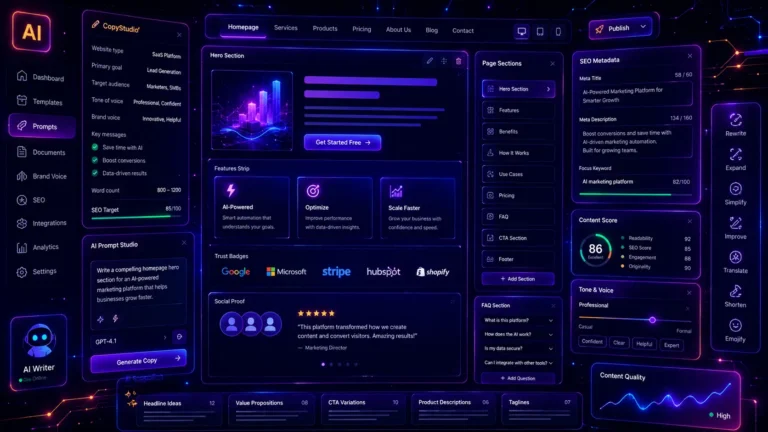
Featured image alt text: Futuristic SEO metadata dashboard with meta title editor, meta description preview, Google snippet card, CTR chart, keyword panel, and AI prompt library in neon UI style.
Featured image title: AI Prompts for Meta Titles and Meta Descriptions
SEO Metadata
SEO title: 30 AI Prompts for Meta Titles and Descriptions
Meta description: Use 30 AI prompts for meta titles, meta descriptions, SEO snippets, CTR improvement, WordPress SEO settings, and page optimization.
Focus keyword: AI prompts for meta titles and descriptions
Secondary keywords: AI meta description prompts, meta title prompts, SEO snippet prompts, ChatGPT meta description prompts, SEO title prompts, meta description generator prompts, CTR optimization prompts, WordPress SEO meta prompts, page optimization prompts