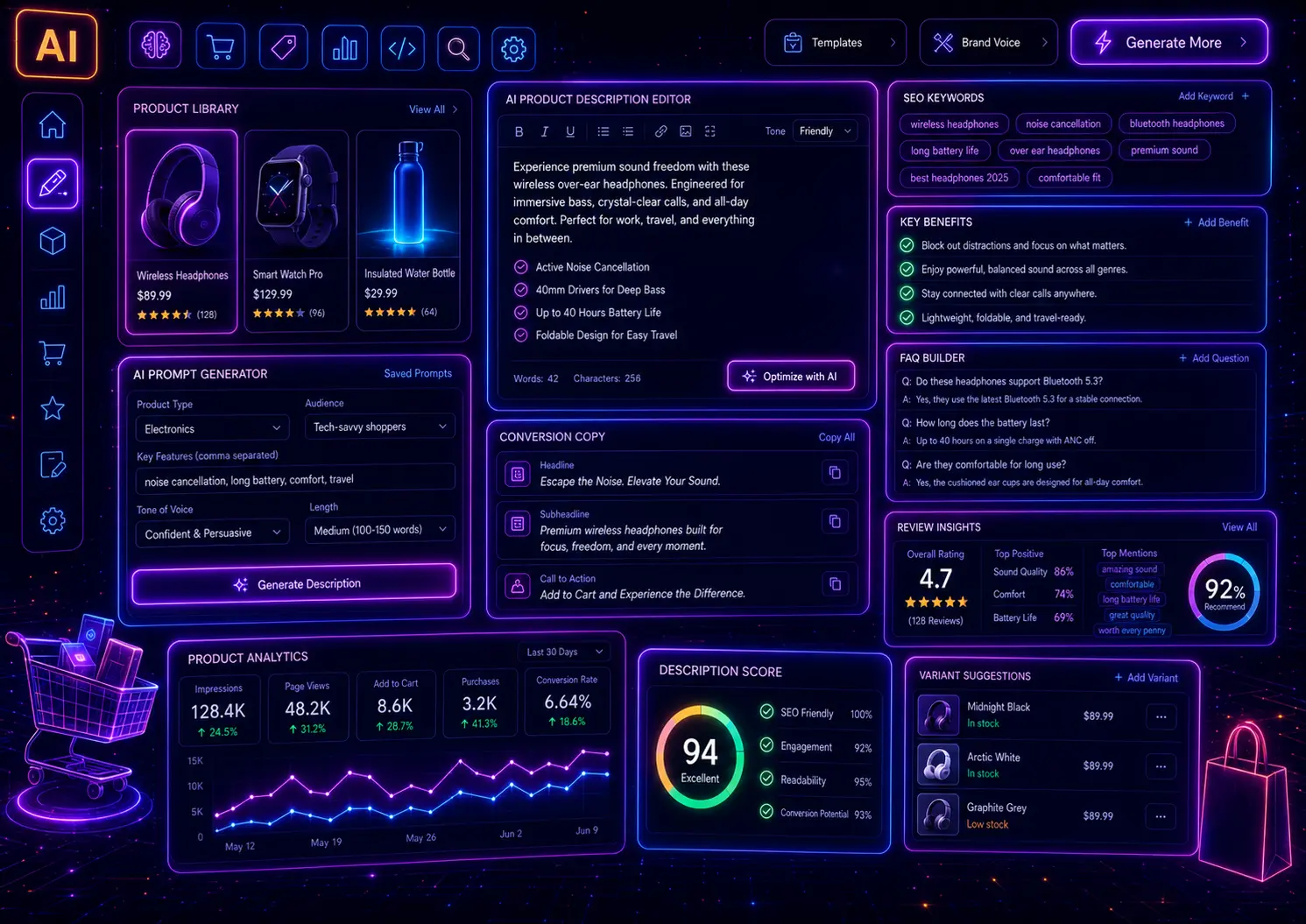
Ecommerce product descriptions are not only short texts under a product image. A strong product description helps the customer understand what the product is, who it is for, why it matters, what problem it solves, and why it is worth buying from your store. A weak AI prompt usually creates generic product copy with empty phrases like “high quality,” “perfect for everyone,” and “must-have product.” A strong ecommerce prompt gives AI the product details, target buyer, search intent, product benefits, objections, tone, SEO keyword, and page goal.
This guide gives you 30 professional AI prompts for ecommerce product descriptions. These prompts are built for real online store workflows: product page descriptions, WooCommerce product copy, Shopify descriptions, category descriptions, short product summaries, SEO product text, benefit-focused copy, feature-to-benefit conversion, comparison copy, luxury product copy, technical product descriptions, FAQ sections, product titles, meta descriptions, and conversion-focused sales text.
This post focuses only on ecommerce product descriptions and product page copy. It does not replace keyword research, full SEO article writing, social media promotion, or landing page copy. For those tasks, use our related guides: ChatGPT prompts for keyword research, ChatGPT prompts for SEO content writing, AI prompts for meta titles and descriptions, and AI prompts for social media posts.
Table of Contents
- What Are AI Prompts for Ecommerce Product Descriptions?
- Why Product Description Prompts Matter
- How to Use These Ecommerce Prompts
- What Should a Good Product Description Prompt Include?
- 30 AI Prompts for Ecommerce Product Descriptions
- Ecommerce Product Description Best Practices
- Common AI Product Description Mistakes
- AI Ecommerce Product Description FAQ
- Conclusion
- Related AI, SEO and Content Guides
What Are AI Prompts for Ecommerce Product Descriptions?
AI prompts for ecommerce product descriptions are structured instructions that help AI write better product copy for online stores. A good ecommerce prompt gives AI the product name, product category, target customer, main use case, important features, real benefits, materials, specifications, objections, tone, SEO keyword, and conversion goal.
A basic prompt might say, “write a product description for this product.” A professional prompt says, “Act as an ecommerce conversion copywriter, write a product description for this product, explain who it is for, turn features into buyer benefits, include SEO keywords naturally, answer objections, and avoid unsupported claims.” The second prompt gives AI the information it needs to create useful product page copy.
These prompts are useful for WooCommerce stores, Shopify stores, product page writers, ecommerce SEO specialists, online shop owners, dropshipping stores, digital product sellers, product marketers, and agencies that need product descriptions that are clearer, more useful, and better aligned with search intent.
Why Product Description Prompts Matter
Product description prompts matter because ecommerce copy has to do more than sound nice. It must help the buyer understand the product, compare options, answer doubts, and take the next step. If the product copy is too generic, the customer may not understand why the product is right for them.
- They make product copy more specific: AI can write around real features, buyer needs, and use cases instead of generic filler.
- They improve SEO structure: Prompts can include primary keywords, related terms, product category language, and FAQ ideas.
- They support conversion: Good prompts help AI explain benefits, answer objections, and write clearer CTAs.
- They save time: Store owners can create first drafts faster while still reviewing details manually.
- They reduce duplicate product text: Better prompts help avoid copy that sounds the same across every product page.
How to Use These Ecommerce Prompts
Each prompt below is copy-paste ready. Replace the bracketed parts such as , [category], [target buyer], [features], [benefits], [primary keyword], [tone], and [store positioning]. The more accurate product information you provide, the better the description will be.
Use these prompts after you understand the product and customer. If you need keyword ideas first, use ChatGPT prompts for keyword research. If you need page-level metadata after the product description, use AI prompts for meta titles and descriptions. If you need to promote products on social media, use AI prompts for social media posts.
What Should a Good Product Description Prompt Include?
Product facts
Give AI real product details: size, material, specifications, features, included items, and limitations.
Target buyer
Explain who the product is for, what they care about, and what problem they are trying to solve.
SEO keyword
Add the primary keyword and related terms so AI can write naturally around ecommerce search intent.
Conversion goal
Tell AI whether the goal is add to cart, quote request, product comparison, lead, download, or inquiry.
30 AI Prompts for Ecommerce Product Descriptions
Below are 30 professional AI prompts for ecommerce product descriptions. Each prompt is focused on one specific product copywriting task, from writing a full product page description to creating short summaries, SEO copy, FAQ sections, category descriptions, and conversion-focused sales text.
1. Complete Product Description Prompt
This prompt creates a full ecommerce product description with features, benefits, use cases, objections, and SEO focus.
How to customize it: Add exact product specifications and real benefits. The better the product facts, the stronger the output.
2. Short Product Description Prompt
This prompt creates a short product summary for WooCommerce short descriptions, product cards, collection pages, or quick product previews.
Why it works: Short descriptions need clarity fast. This prompt creates different lengths for different store layouts.
3. Feature-to-Benefit Product Copy Prompt
This prompt converts product features into buyer benefits. It is useful when product information is too technical or too feature-heavy.
How to use it: Paste raw product specs. AI will help translate them into benefits customers understand.
4. SEO Product Description Prompt
This prompt creates product copy that uses ecommerce keywords naturally without stuffing the page.
Why it works: Ecommerce SEO copy should match buyer intent and product facts, not repeat keywords unnaturally.
5. WooCommerce Product Description Prompt
This prompt is built for WooCommerce product pages, including short description, long description, tabs, and FAQ sections.
How to customize it: Add your real product specs and shipping notes. Do not let AI guess operational details.
6. Shopify Product Description Prompt
This prompt creates Shopify-friendly product descriptions with a clear structure, benefit bullets, and buyer-focused copy.
Why it works: Shopify pages often need clean, scannable copy that helps buyers quickly understand product value.
Need better ecommerce product descriptions?
If your product pages are too generic, too short, or not built for SEO and conversions, we can help improve WooCommerce product copy, category text, product FAQs, and metadata.
Contact Us7. Product Title Optimization Prompt
This prompt creates clearer product titles for ecommerce search, product grids, category pages, and SEO snippets.
How to use it: Use this when product names are too vague, too technical, or missing important buyer attributes.
8. Product Bullet Points Prompt
This prompt creates clear ecommerce bullet points for product pages, product cards, Amazon-style listings, and comparison sections.
Why it works: Product bullets help buyers scan important details before reading the full description.
9. Product FAQ Prompt
This prompt creates product FAQ questions and answers that help customers make a decision and reduce support questions.
How to customize it: Add real customer questions from support emails, live chat, reviews, or Search Console queries.
10. Product Objection Handling Prompt
This prompt helps answer buyer doubts directly, such as price, fit, quality, size, compatibility, setup, or use case concerns.
Why it works: Better product copy often comes from answering what buyers are worried about, not only listing features.
11. Product Comparison Copy Prompt
This prompt creates comparison copy for helping buyers choose between similar products, models, sizes, or packages.
How to use it: Use this for product families, size variants, bundles, materials, packages, or similar models.
12. Product Category Description Prompt
This prompt creates ecommerce category descriptions for SEO, product browsing, and buyer education.
Why it works: Category pages need SEO text, but they must still help buyers choose the right product group.
Need ecommerce category and product copy that helps buyers?
We can help create better product descriptions, category text, FAQ sections, SEO snippets, and internal linking for WooCommerce and other ecommerce websites.
Improve My Product Pages13. Technical Product Description Prompt
This prompt creates product descriptions for technical products where accuracy, specifications, and buyer clarity are important.
How to customize it: Add complete technical data. AI should explain the specs, not guess them.
14. Luxury Product Description Prompt
This prompt creates premium product copy without overusing empty luxury words or unsupported claims.
Why it works: Premium copy should feel specific and refined, not overloaded with generic luxury adjectives.
15. Budget Product Description Prompt
This prompt creates product copy for affordable products without making the product sound cheap or low value.
How to use it: This works well for entry-level, budget-friendly, starter, or practical everyday products.
16. Digital Product Description Prompt
This prompt creates product copy for digital downloads, templates, plugins, courses, files, tools, and online resources.
Why it works: Digital products need clear expectations: what the buyer gets, how it works, and who it is for.
17. Product Bundle Description Prompt
This prompt creates ecommerce copy for product bundles, kits, packages, sets, starter packs, and combined offers.
How to customize it: Add the exact items in the bundle. Never let AI guess what is included.
18. Product Storytelling Prompt
This prompt creates a product story that explains the problem, use case, and product value in a more engaging way.
Why it works: Some products need context. Storytelling helps buyers imagine how the product fits their life or work.
Need product pages that explain value clearly?
We can help write or improve product pages, product bundles, digital product descriptions, product comparison sections, and FAQ blocks that support SEO and conversions.
Fix My Product Copy19. Product Description Rewrite Prompt
This prompt improves an existing product description by making it clearer, more useful, and more conversion-focused.
How to use it: Paste your current text. This is useful for updating old product pages that were copied from supplier descriptions.
20. Duplicate Product Description Prompt
This prompt helps rewrite similar supplier descriptions into unique, buyer-focused ecommerce copy.
Why it works: Many ecommerce stores reuse supplier text. This prompt helps create more original and useful copy.
21. Product Page Conversion Audit Prompt
This prompt reviews a product page and identifies what is missing from the copy before you publish or update it.
How to use it: Use this before publishing important product pages or when product pages get traffic but weak sales.
22. Product Page SEO Metadata Prompt
This prompt creates SEO title, meta description, focus keyword, secondary keywords, and image alt text for product pages.
Why it works: Product metadata should match the product page, not reuse the category description or first paragraph.
23. Product Image Alt Text Prompt
This prompt creates accurate image alt text for product photos, product galleries, lifestyle images, and detail shots.
How to customize it: Describe the image accurately. Alt text should help users understand the image, not only SEO.
24. Product Review Summary Prompt
This prompt summarizes real product reviews into useful product page insights without inventing testimonials.
Why it works: Real customer language can improve product descriptions and help answer buyer questions more naturally.
Want stronger SEO metadata and product page structure?
We can help optimize ecommerce SEO titles, meta descriptions, image alt text, product FAQs, review summaries, and product page content for better clarity and search performance.
Optimize My Ecommerce SEO25. Product Email Copy Prompt
This prompt turns product information into promotional email copy for ecommerce campaigns, product launches, and product recommendations.
How to use it: Use this for product launches, abandoned browse campaigns, product recommendation emails, and seasonal promotions.
26. Product Social Media Copy Prompt
This prompt creates platform-specific social media posts from product page details.
Why it works: Product page copy and social media copy should connect, but social posts need platform-specific wording.
27. Product Page Internal Linking Prompt
This prompt helps plan internal links from product pages to categories, buying guides, comparison posts, and related products.
How to use it: Use this to connect products with categories, guides, and related buying decisions.
28. Product Page Content Gap Prompt
This prompt identifies missing product page content, such as specifications, benefits, FAQ answers, objections, and comparison details.
Why it works: Many product pages fail because they do not answer enough buyer questions before the purchase decision.
29. Bulk Product Description Prompt
This prompt helps create product descriptions for multiple products while keeping each product unique and specific.
How to use it: This is useful for ecommerce stores with many products, but every output should still be checked manually.
30. Complete Ecommerce Product Copy Workflow Prompt
This prompt creates a full repeatable AI workflow for product descriptions, SEO metadata, FAQs, internal links, and product promotion.
Why it works: Ecommerce copy works better when product data, SEO, benefits, FAQs, metadata, and promotion are part of one workflow.
Need a full ecommerce product copy system?
If you want better product descriptions, WooCommerce product pages, category descriptions, product SEO metadata, FAQs, and internal linking, we can help build a clear ecommerce content workflow.
Contact UsEcommerce Product Description Best Practices
AI can help write ecommerce product descriptions faster, but product copy still needs real product information and human review. A good product description should explain the product clearly, translate features into buyer benefits, answer objections, include useful details, and support the page’s SEO keyword naturally.
- Start with product facts: AI should work from real specifications, materials, sizes, compatibility, and included items.
- Write for the buyer: Explain who the product is for and why it helps them.
- Turn features into benefits: Do not only list specs. Explain what those specs mean for the customer.
- Use keywords naturally: Product keywords should fit the copy, not be forced into every sentence.
- Add product FAQs: FAQs help answer doubts and improve product page usefulness.
- Avoid unsupported claims: Do not let AI invent reviews, guarantees, certifications, stock, discounts, or delivery times.
- Keep pages unique: Avoid using the same product description pattern across every product.
Common AI Product Description Mistakes
The biggest mistake is asking AI to write product descriptions without giving real product data. When AI does not know the product, it fills the copy with generic phrases and may invent details. Ecommerce copy must stay accurate because customers use it to make buying decisions.
- Generic product claims: Phrases like “premium quality” and “perfect for any occasion” do not help unless supported by details.
- Invented product facts: AI may create materials, sizes, compatibility, guarantees, or certifications if the prompt is vague.
- Keyword stuffing: Repeating the product keyword too often makes the page unnatural.
- Ignoring objections: Buyers may hesitate because of size, compatibility, price, setup, or use case questions.
- Copying supplier text: Supplier descriptions often appear on many stores and may not be unique or buyer-focused.
- Using one template for all products: Bulk product copy should still be specific to each product.
AI Ecommerce Product Description FAQ
Can AI write ecommerce product descriptions?
Yes, AI can write ecommerce product descriptions when you provide real product details, target buyer information, SEO keywords, product benefits, and clear quality rules. Human review is still important before publishing.
What is the best AI prompt for product descriptions?
The best prompt gives AI the product name, category, buyer, features, specifications, benefits, objections, tone, primary keyword, and conversion goal. It should also tell AI not to invent facts.
Can AI help with WooCommerce product descriptions?
Yes. AI can create WooCommerce short descriptions, long descriptions, product FAQs, benefit bullets, SEO titles, meta descriptions, and image alt text for product pages.
How do I avoid generic AI product descriptions?
Add specific product facts, buyer needs, use cases, limitations, benefits, and brand tone. Ask AI to remove vague phrases and explain features in buyer-friendly language.
Should AI write product SEO keywords?
AI can suggest keyword ideas and related terms, but important product keywords should be validated with keyword research, Search Console data, or ecommerce SEO tools.
Can AI rewrite supplier product descriptions?
Yes. AI can help rewrite supplier descriptions into more unique, useful, and buyer-focused product copy. You must still keep technical facts accurate and avoid inventing features.
Conclusion
AI can make ecommerce product description writing faster, but the quality depends on the prompt and the product information you provide. A strong ecommerce prompt gives AI the product facts, target buyer, use cases, benefits, objections, SEO keyword, tone, and conversion goal. This helps create product copy that is clearer, more useful, and easier for customers to trust.
Use these 30 AI prompts as a practical product copy workflow. Start with product data, write short and long descriptions, turn features into benefits, create product FAQs, optimize metadata, write image alt text, plan internal links, and promote the product with social media copy. For stronger SEO planning, connect this guide with ChatGPT prompts for keyword research, AI prompts for meta titles and descriptions, and AI prompts for social media posts.
Related AI, SEO and Content Guides
- 30 ChatGPT Prompts for SEO Content Writing
- 30 ChatGPT Prompts for Keyword Research
- 30 AI Prompts for Meta Titles and Meta Descriptions
- 30 AI Prompts for Social Media Posts
- 30 ChatGPT Prompts for WordPress Websites
- 30 AI Prompts for Website Copywriting
- 30 AI Prompts for Landing Pages
- 30 AI Prompts for Customer Support
- JavaScript Search Filter Examples
- Modern CSS Card Examples
Image SEO
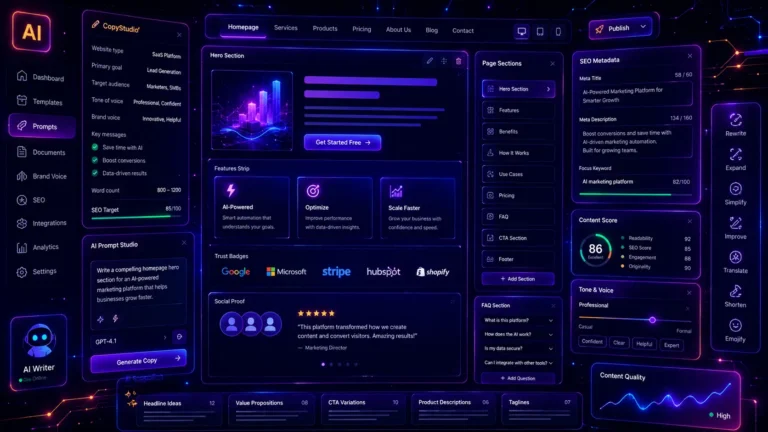
Featured image alt text: Futuristic ecommerce AI dashboard with product description editor, product cards, SEO keyword panel, conversion copy blocks, review insights, and neon prompt generator interface.
Featured image title: AI Prompts for Ecommerce Product Descriptions
SEO Metadata
SEO title: 30 AI Prompts for Ecommerce Product Descriptions
Meta description: Use 30 AI prompts for ecommerce product descriptions, SEO product copy, WooCommerce descriptions, product FAQs, sales text, and metadata.
Focus keyword: AI prompts for ecommerce product descriptions
Secondary keywords: ecommerce product description prompts, AI product description prompts, ChatGPT product description prompts, WooCommerce product description prompts, Shopify product description prompts, SEO product descriptions, ecommerce copywriting prompts, product page prompts, product FAQ prompts, product sales copy prompts