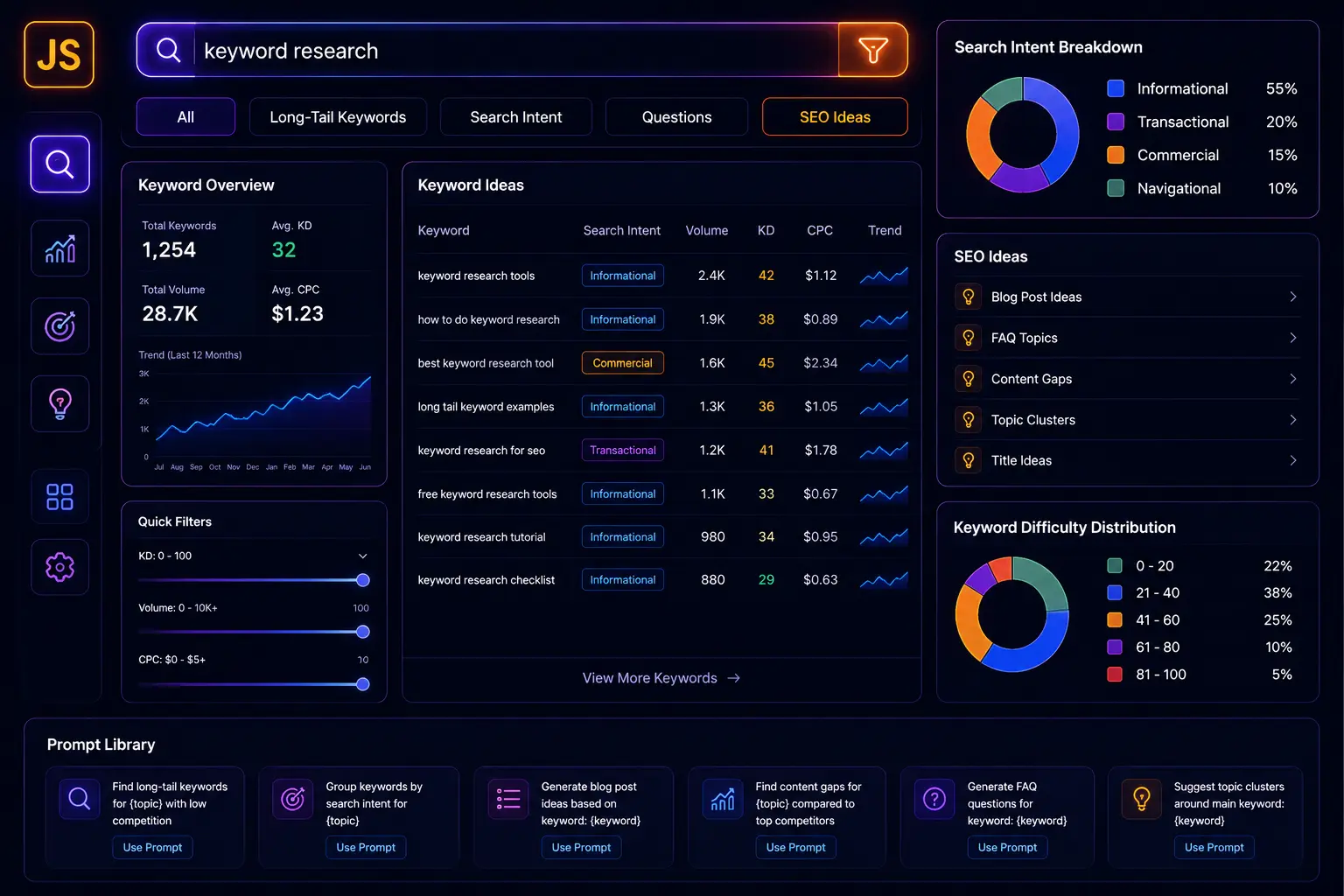
Keyword research is one of the most important steps in SEO, but many people use AI for it in the wrong way. A weak prompt asks ChatGPT to “give me keywords” and usually gets a random list. A strong keyword research prompt asks AI to separate search intent, find long-tail keyword ideas, group related topics, identify content gaps, build topical clusters, and explain which keywords are worth targeting with separate pages.
This guide gives you 30 professional ChatGPT prompts for keyword research. These prompts are built for real SEO workflows: seed keyword expansion, long-tail keyword discovery, search intent analysis, topic clustering, content calendar planning, competitor gap research, local SEO keywords, ecommerce keyword ideas, blog post keyword mapping, and keyword cannibalization prevention.
This article focuses only on keyword research and SEO topic planning. It does not try to write full blog posts, meta descriptions, landing page copy, product descriptions, or social media content. For those tasks, use our related guides: ChatGPT prompts for SEO content writing, AI prompts for meta titles and descriptions, AI prompts for ecommerce product descriptions, and AI prompts for landing pages.
Table of Contents
- What Are ChatGPT Keyword Research Prompts?
- Why AI Keyword Research Prompts Matter
- How to Use These Keyword Research Prompts
- What Should a Good Keyword Research Prompt Include?
- 30 ChatGPT Prompts for Keyword Research
- Keyword Research Prompt Best Practices
- Common AI Keyword Research Mistakes
- ChatGPT Keyword Research FAQ
- Conclusion
- Related AI, SEO and Content Guides
What Are ChatGPT Keyword Research Prompts?
ChatGPT keyword research prompts are structured instructions that help AI generate, group, analyze, and prioritize keyword ideas. Instead of asking for a random keyword list, a strong prompt gives ChatGPT context about your website, audience, niche, search intent, content goals, and existing pages.
AI keyword research is especially useful for brainstorming long-tail keywords, finding topic angles, building content clusters, separating informational and commercial intent, identifying FAQ ideas, and mapping keywords to different types of pages. It can also help you avoid publishing multiple posts that target the same search intent.
However, ChatGPT should not be treated as a replacement for keyword data tools. It does not reliably provide real-time search volume, competition, or click data unless connected to a live data source. The best approach is to use ChatGPT for strategy, structure, clustering, and idea generation, then validate important keywords with tools such as Google Search Console, Google Keyword Planner, Ahrefs, Semrush, or other SEO platforms.
Why AI Keyword Research Prompts Matter
Good keyword research prompts matter because keyword research is not only about finding words. It is about understanding what people want, what content format they expect, what stage of the journey they are in, and which page should answer each search.
- They help find long-tail opportunities that are more specific than broad head keywords.
- They separate search intent so you do not mix tutorials, comparisons, product pages, and service pages into one messy article.
- They support topical authority by grouping related keywords into content clusters.
- They reduce keyword cannibalization by mapping keywords to separate URLs.
- They improve content planning by turning keyword ideas into article topics, outlines, and publishing priorities.
How to Use These Keyword Research Prompts
Use these prompts as a research and planning assistant. Replace the bracketed parts such as [seed keyword], [niche], [audience], [website], [country], and [existing URLs]. The more context you give, the better the output will be.
For best results, use the prompts in sequence. Start with seed keyword expansion, then analyze search intent, group keywords into clusters, map topics to article ideas, and finally check for overlap with existing content. After that, validate the most important keyword ideas with SEO data tools before publishing.
What Should a Good Keyword Research Prompt Include?
Seed topic
Start with a clear topic, product, service, niche, or audience problem so AI knows the direction.
Search intent
Ask AI to separate informational, commercial, transactional, local, and comparison keywords.
Keyword grouping
Request clusters, parent topics, related subtopics, and page mapping instead of one flat keyword list.
Validation rules
Tell AI to mark ideas that require real search volume, SERP, competition, or Search Console validation.
30 ChatGPT Prompts for Keyword Research
Below are 30 professional ChatGPT prompts for keyword research. Each prompt is designed for a specific SEO planning task, from seed keyword expansion to content cluster mapping and keyword cannibalization checks.
1. Seed Keyword Expansion Prompt
This prompt turns one broad topic into a structured list of keyword ideas. It is useful at the start of keyword research when you need direction.
How to customize it: Add the niche, audience, and country. Use this as the first brainstorming step before checking real keyword data.
2. Long-Tail Keyword Discovery Prompt
This prompt helps you find specific long-tail keyword ideas that can become focused blog posts or sections inside a larger guide.
Why it works: Long-tail keywords often reveal clearer user problems. This prompt connects each keyword to intent and content type.
3. Search Intent Classification Prompt
This prompt groups keyword ideas by intent so you do not mix informational, commercial, comparison, and transactional keywords into the wrong page.
How to use it: Paste keyword ideas from Google Search Console, Ahrefs, Semrush, or ChatGPT brainstorming, then map them to correct page types.
4. Keyword Clustering Prompt
This prompt groups related keywords into clusters so you can decide which ideas belong on the same page and which need separate articles.
Why it works: Clustering helps prevent thin content and overlapping posts. It creates a cleaner SEO architecture.
5. Blog Post Keyword Mapping Prompt
This prompt maps keywords to individual blog post ideas. It is helpful when building a content calendar from keyword research.
How to customize it: Add your existing posts so ChatGPT avoids suggesting topics that compete with pages already published.
6. Question Keyword Prompt
This prompt creates question-based keyword ideas for FAQ sections, how-to articles, and helpful content blocks.
Why it works: Question keywords reveal reader problems. This prompt connects each question to the best content format.
Need help turning keyword ideas into a real SEO content plan?
If you have keywords but do not know what to publish, we can help you build a content map, internal linking structure, WordPress blog plan, and AI-assisted SEO workflow that avoids overlapping posts.
Contact Us7. Competitor Keyword Gap Prompt
This prompt helps analyze competitor topics and find keyword gaps without copying their content.
How to use it: Paste competitor headings or keyword exports. The goal is to find gaps, not duplicate their article.
8. Topical Authority Map Prompt
This prompt builds a topical authority map around a main niche. It is useful for planning 10-30 related posts.
Why it works: A topical map helps build authority over time instead of publishing random posts that do not support each other.
9. Search Console Opportunity Prompt
This prompt helps turn Google Search Console queries into content opportunities and update ideas.
How to use it: Export queries from Google Search Console and paste them here. This is better than brainstorming without real site data.
10. Content Calendar Keyword Prompt
This prompt turns keyword ideas into a content calendar with priorities, intent, and internal linking notes.
Why it works: It turns keyword research into a publishing plan, which is easier to execute than a loose keyword list.
11. Local SEO Keyword Prompt
This prompt creates local keyword ideas for service businesses, agencies, contractors, clinics, shops, and local landing pages.
How to use it: Use this for location pages, service pages, and FAQ planning. Validate search behavior with real local SEO data.
12. Ecommerce Keyword Prompt
This prompt helps ecommerce sites find product, category, comparison, and buying-guide keyword opportunities.
Why it works: Ecommerce SEO needs different page types. This prompt separates category, product, comparison, and guide intent.
Need ecommerce or service keyword research that becomes real pages?
We can help turn keyword research into WordPress pages, WooCommerce category structures, blog posts, service landing pages, and internal linking plans that support SEO and conversions.
Build My SEO Plan13. Commercial Intent Keyword Prompt
This prompt identifies keywords where the searcher is closer to comparing, evaluating, or buying.
How to use it: Use this when the goal is not only traffic, but leads, quote requests, demos, or sales.
14. Informational Keyword Prompt
This prompt finds educational keyword ideas for blog posts that build awareness and topical authority.
Why it works: Informational keywords help build trust and topical authority, but they still need clear reader problems and useful formats.
15. Comparison Keyword Prompt
This prompt finds comparison keywords for articles where readers are choosing between tools, services, products, or methods.
How to use it: Use this for commercial investigation content where readers need help making a decision.
16. Keyword Cannibalization Prevention Prompt
This prompt checks whether new keyword ideas overlap with existing content and should be merged, narrowed, or split.
Why it works: It protects your site from creating multiple pages that target the same searcher goal.
17. Low-Competition Keyword Brainstorm Prompt
This prompt helps brainstorm more specific keyword angles that may be easier to target than broad competitive terms.
How to use it: Use this when your site is new or when broad keywords are dominated by large websites.
18. Existing Content Keyword Expansion Prompt
This prompt finds keyword opportunities from content you already have, making it useful for updating and expanding published posts.
Why it works: It helps expand an article without turning it into an unfocused page that targets too many unrelated keywords.
Want keyword research that avoids cannibalization?
A strong SEO plan needs clear keyword mapping, page intent, content boundaries, and internal links. We can help you build a clean structure where each post has a clear purpose.
Plan My SEO Structure19. Keyword-to-Outline Prompt
This prompt turns one keyword cluster into a practical article outline without writing the full post.
How to use it: Use this after clustering keywords. It connects keyword research with article planning.
20. Service Page Keyword Prompt
This prompt finds keywords for service pages and supporting blog content around a service business.
Why it works: Service SEO needs pages that match buying intent, local intent, and problem-based informational intent.
21. SaaS Keyword Prompt
This prompt helps SaaS companies find keywords for use cases, features, integrations, alternatives, and comparison pages.
How to use it: SaaS keyword research should connect content to product value, not only broad blog traffic.
22. Affiliate Keyword Prompt
This prompt creates affiliate keyword ideas focused on product comparisons, buying guides, alternatives, and use cases.
Why it works: Affiliate content needs to match buyer intent while staying useful and trustworthy.
23. WordPress Keyword Prompt
This prompt finds WordPress-related keyword ideas for tutorials, plugin guides, theme help, WooCommerce content, and troubleshooting posts.
How to use it: Connect WordPress keyword ideas with future posts like ChatGPT prompts for WordPress websites.
24. Blog Category Keyword Prompt
This prompt helps build a keyword plan for a whole blog category instead of a single post.
Why it works: It helps create a category like this AI prompt series, where each post has a separate search intent.
Building a new blog category?
A strong category needs keyword separation, internal linking, consistent templates, and clear search intent. We can help you plan the structure and build the WordPress content system.
Get Category Help25. Keyword Priority Scoring Prompt
This prompt helps prioritize keyword ideas based on business value, intent, difficulty assumptions, and content fit.
How to use it: Use this after brainstorming. It helps you decide what to write first instead of publishing randomly.
26. SERP Analysis Preparation Prompt
This prompt prepares a SERP analysis checklist so you know what to check manually in search results.
Why it works: ChatGPT can guide the process, but live SERP validation should still be done manually or with SEO tools.
27. Keyword Modifier Prompt
This prompt creates keyword modifiers that reveal different search intents, such as examples, templates, tools, pricing, mistakes, and comparisons.
How to use it: This is useful when you need more specific angles from one core topic.
28. Keyword-to-Internal-Link Prompt
This prompt turns keyword mapping into internal linking recommendations between existing and planned posts.
Why it works: Internal linking should connect related tasks and search intents, not just place links everywhere.
29. Keyword Validation Checklist Prompt
This prompt creates a checklist for validating keyword ideas before you invest time writing content.
How to use it: Use this before writing. It helps prevent publishing articles for keywords that do not fit your site or business goal.
30. Complete Keyword Research Workflow Prompt
This prompt creates a complete repeatable workflow for keyword research, clustering, validation, and content planning.
Why it works: It turns keyword research into a repeatable system that connects AI brainstorming with real SEO validation.
Need help building a keyword research and content workflow?
If you want keyword research, article planning, internal linking, WordPress SEO structure, or AI-assisted content workflows that avoid overlap and support growth, we can help.
Contact UsKeyword Research Prompt Best Practices
ChatGPT is useful for keyword research planning, but it works best when you use it for brainstorming, grouping, intent analysis, and content mapping. It should not be the only source of keyword decisions. Use AI to create a smarter research structure, then validate important keywords with real SEO data.
- Start with a clear seed topic. Give ChatGPT your niche, audience, country, and business goal.
- Separate intent early. Do not mix informational, commercial, local, transactional, and comparison keywords into one page.
- Cluster by reader goal. Keywords that look similar may still need separate pages if search intent is different.
- Validate important keywords. Use Google Search Console, keyword tools, and manual SERP checks before investing heavily.
- Map keywords to URLs. Every important keyword should have a clear target page.
- Avoid keyword stuffing. Keyword research should guide content structure, not force unnatural wording.
- Use internal links strategically. Link related posts where the reader naturally needs the next step.
Common AI Keyword Research Mistakes
The biggest mistake is using AI keyword research as a final keyword list. ChatGPT can generate useful ideas, but it can also create phrases that sound plausible but may not have meaningful search demand. Treat AI output as a starting point, not the final truth.
- Trusting fake volume: Do not ask ChatGPT for exact search volume unless it is connected to real data.
- Publishing without SERP checks: Always check what type of pages rank before choosing the article format.
- Ignoring intent: A keyword list without intent classification can lead to the wrong page type.
- Creating overlapping posts: Use keyword mapping to avoid multiple articles targeting the same searcher goal.
- Using only broad keywords: Long-tail keywords often reveal clearer problems and better article angles.
- Forgetting business value: Traffic alone is not enough. Prioritize keywords that support your website goals.
ChatGPT Keyword Research FAQ
Can ChatGPT do keyword research?
Yes, ChatGPT can help with keyword research brainstorming, search intent analysis, keyword clustering, content planning, and keyword mapping. However, it should not be used as the only source for real search volume or competition data.
Can ChatGPT provide accurate search volume?
Not reliably by itself. ChatGPT can suggest keyword ideas, but search volume should be validated with tools such as Google Keyword Planner, Google Search Console, Ahrefs, Semrush, or other SEO platforms.
What is the best ChatGPT prompt for keyword research?
The best prompt depends on the task. Start with seed keyword expansion, then use search intent classification, keyword clustering, and keyword-to-content mapping prompts.
How do I avoid keyword cannibalization with AI keyword research?
Use prompts that map each keyword to a specific URL and clearly define what each page should and should not cover. Related keywords should be grouped by search intent, not only by similar words.
Should I use ChatGPT before or after keyword tools?
You can use ChatGPT both before and after keyword tools. Use it before tools to brainstorm ideas and after tools to classify, cluster, prioritize, and map validated keyword data.
Can these prompts help with blog content planning?
Yes. These prompts are useful for turning keyword ideas into blog post topics, content calendars, topical maps, article outlines, and internal linking plans.
Conclusion
ChatGPT can make keyword research faster and more structured when you use it with the right prompts. Instead of asking for random keyword lists, use AI to expand seed topics, discover long-tail ideas, classify search intent, cluster related keywords, map topics to URLs, and build content calendars that support your SEO goals.
The most important rule is to validate AI-generated keyword ideas before publishing. ChatGPT is excellent for strategy and organization, but real keyword data, Search Console queries, competitor SERPs, and manual review still matter. Use these prompts to build a smarter workflow, then connect the best keyword ideas with strong SEO content using our ChatGPT prompts for SEO content writing.
Related AI, SEO and Content Guides
- 30 ChatGPT Prompts for SEO Content Writing
- 30 AI Prompts for Meta Titles and Meta Descriptions
- 30 AI Prompts for Social Media Posts
- 30 AI Prompts for Ecommerce Product Descriptions
- 30 ChatGPT Prompts for WordPress Websites
- 30 AI Prompts for Website Copywriting
- JavaScript Search Filter Examples
- Modern CSS Layout Examples
Image SEO
Featured image alt text: AI keyword research dashboard with long-tail keyword clusters, search intent cards, SEO topic map, and content planning workflow interface.
Featured image title: ChatGPT Prompts for Keyword Research
SEO Metadata
SEO title: 30 ChatGPT Prompts for Keyword Research – Long-Tail Keywords & SEO Ideas
Meta description: Use these 30 professional ChatGPT prompts for keyword research, long-tail keywords, search intent, topic clusters, content calendars, and SEO planning.
Focus keyword: ChatGPT prompts for keyword research
Secondary keywords: AI keyword research prompts, ChatGPT keyword research prompts, long-tail keyword prompts, SEO keyword prompts, search intent prompts, keyword clustering prompts, AI prompts for keyword research, SEO content planning prompts