


Introduction
Small businesses increasingly look to AI-powered customer service for tangible results, but understanding the true AI customer service ROI for small business is crucial before investing. The main drivers—cost savings, increased sales, and improved customer satisfaction—must be measured with clarity, not hype. Recent industry data shows small businesses report an average return of over $3 for every $1 spent on AI customer support, with leading adopters seeing up to 8x ROI. However, these gains depend on careful measurement and realistic expectations, not just installing a chatbot or automation tool. Factors such as staff training, integration with existing systems, and ongoing monitoring play significant roles in realizing these benefits. Additionally, hidden costs—such as setup time, software updates, and data privacy considerations—should be factored into any ROI calculation to ensure a comprehensive assessment.
This article provides a step-by-step framework to accurately measure and interpret your own AI customer service ROI, using proven metrics such as First Response Time, Resolution Time, satisfaction scores, and conversion rates. By following a structured approach, you will learn how to collect relevant data, benchmark your results, and avoid common pitfalls that lead to misleading conclusions. We address not only the numbers, but also the practical realities and risks unique to small business environments, such as resource constraints and integration challenges. Additional guidance is offered on how to align AI initiatives with overall business goals, adapt to changing customer expectations, and ensure that technology investments remain agile as your business grows.
By the end, you will be able to make well-informed decisions about adopting, scaling, or optimizing AI customer service in your business—moving beyond generic promises to clear, actionable insights that drive measurable business outcomes.

Debunking Myths: The Real ROI of AI Customer Service for Small Businesses
The value of AI-first customer service extends beyond cost savings, as it also enhances support quality, scalability, and overall business impact.
According to Freshworks, small businesses leveraging AI tools experienced a 36.39% improvement in Resolution Time when handling customer queries.
Small businesses using Freddy AI Copilot have reported a 41.56% improvement in First Response Time, highlighting measurable efficiency gains from AI adoption.
Myth Versus Fact: Understanding ROI Expectations
Small business owners face conflicting messages about the return on investment (ROI) of AI-powered customer service. Industry surveys reveal that both hype and isolated anecdotes can distort expectations—leading some to overestimate quick wins, while others dismiss AI as costly or impersonal. A clear-eyed look at recent benchmarks and survey data helps ground decisions in reality, not speculation.
Many small businesses enter the AI adoption journey with either inflated hopes of immediate, dramatic transformation or skepticism fueled by stories of failed implementations. The truth often lies between these extremes. While early adopters sometimes report rapid improvements, broader industry data underscores that realizing ROI requires strategic alignment with business goals, thoughtful integration, and ongoing management. Studies show that the most successful small businesses set realistic timelines, pilot AI solutions with clear objectives, and measure both quantitative and qualitative outcomes. This approach helps separate the signal from the noise, enabling owners to make informed decisions based on relevant metrics rather than marketing promises or isolated anecdotes. Ultimately, understanding the real ROI of AI in customer service means focusing on evidence-backed results and continuous optimization, not quick fixes or one-size-fits-all solutions.
Fact: AI Adoption Is Widespread—But Human Teams Remain Essential
According to a recent Talkdesk survey, over half of US small businesses now use AI within their customer support operations. Crucially, 94% of these businesses plan to maintain or expand their human customer service teams, not replace them. This pattern shows that AI customer service solutions typically augment staff by automating routine tasks and triaging requests, rather than eliminating the need for human expertise and empathy. In practice, AI frees up human agents to handle complex queries, while maintaining a consistent customer experience.
This blended approach is becoming a best practice, as it leverages the strengths of both technology and people. AI chatbots and virtual assistants can handle repetitive inquiries, provide instant responses outside business hours, and gather customer information before passing it to a human agent. This not only streamlines operations but also helps reduce burnout and turnover among support staff. Meanwhile, humans remain critical for resolving nuanced issues, building rapport, and delivering personalized service—factors that strengthen customer loyalty. The net effect is a more resilient support system that adapts to fluctuating demand, delivering better outcomes for both customers and employees.
Fact: Measurable ROI Benchmarks Outpace Many Expectations
Recent industry benchmarks, such as those published by Fin AI, indicate that leading small businesses report average returns of $3.50 for every $1 invested in AI-powered customer support. Some organizations achieve as much as an 8x ROI, depending on the scope and integration of AI tools with existing workflows. These figures result from a mix of direct cost reductions, process acceleration, and higher sales conversion rates. However, results vary and depend on proper metric tracking and continuous optimization of both AI and human support processes.
Realizing these returns often hinges on the scale of automation and the careful selection of use cases. High-impact areas include automating FAQs, processing routine transactions, and providing instant responses during peak periods. Additionally, AI can help identify sales opportunities by analyzing customer intent, leading to increased upselling and cross-selling. Businesses that establish clear KPIs—such as ticket resolution rates, reduction in average response time, and improvements in customer satisfaction—are better equipped to quantify and maximize their AI ROI. The most effective strategies also involve regular review of AI performance data to identify gaps and adapt workflows accordingly.
Myth: AI Customer Service Is Only About Cost Cutting
It is a common misconception that AI in customer service is valuable solely for reducing operational expenses. While cost savings are often among the first outcomes, the Harvard Business Review and other industry analyses have shown that AI also drives improvements in customer satisfaction, service quality, and business growth. For example, AI can enable faster first responses, 24/7 availability, and personalized recommendations—factors that directly influence customer loyalty and recurring revenue. Failing to account for these qualitative gains can lead to underestimating the full impact of AI investments.
Beyond operational efficiencies, AI-powered customer service solutions contribute to stronger brand reputation and customer retention. Instant support availability can differentiate a small business in crowded markets, while AI-driven insights help tailor offers and communications to individual preferences. These enhancements, though less tangible than cost savings, often yield long-term value by increasing lifetime customer value and positive word-of-mouth referrals. As a result, businesses that look beyond cost metrics and track broader indicators of customer engagement tend to realize a more comprehensive and sustainable ROI from their AI investments.
Fact: Small Business ROI Is Multi-Dimensional
Leading small businesses measure AI customer service ROI using a wider lens. Commonly tracked metrics include First Response Time, Resolution Time, customer satisfaction (CSAT), the volume and resolution rate of support tickets, and sales conversion metrics linked to AI-powered interactions. Higher ROI correlates with the ability to attribute revenue gains and satisfaction improvements to AI engagement, not just reduced headcount or response costs. Businesses that rigorously track these metrics are better positioned to optimize both the AI tools and the workflows they support.
Advanced analytics platforms make it easier for small businesses to connect AI activity with business outcomes. For instance, tracking the percentage of customer issues resolved without human intervention or monitoring changes in repeat purchase rates after implementing AI-powered service can reveal new value streams. Regularly reviewing these multi-dimensional metrics allows businesses to refine their AI strategies, reallocate resources, and prioritize features that drive the greatest impact. Ultimately, a holistic approach to ROI measurement provides a clearer picture of how AI investments contribute to business growth and customer satisfaction over time.
Myth: AI ROI Is Too Unpredictable for Small Businesses
Some decision-makers believe that AI’s value is unpredictable or only accessible to large enterprises. In reality, small business case studies and surveys demonstrate that the most significant challenges are not technical barriers, but rather a lack of clear measurement frameworks and realistic expectations. By focusing on actionable metrics and continuous improvement, small businesses can reduce risk and systematically increase the ROI of their AI customer service initiatives.
Many successful small businesses start with pilot projects, using them to validate assumptions about customer needs and operational impact before scaling up. This iterative approach, combined with regular performance reviews and feedback loops, helps minimize risk and ensures investments are aligned with evolving business goals. The growing ecosystem of affordable AI tools and integrations tailored for small businesses also makes adoption more accessible and predictable than ever before. With the right planning, measurement, and support, small businesses can unlock reliable, data-driven ROI from AI-powered customer service.
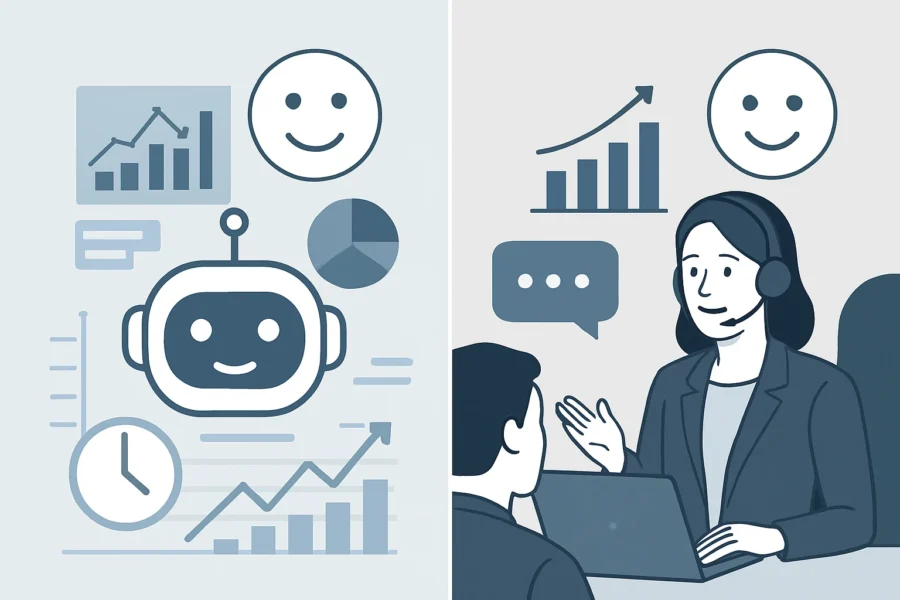
Comparison Table: AI vs Traditional Customer Service ROI
Companies that invest in AI-powered support typically see average returns of .50 for every spent, with some leading organizations achieving even higher ROI.
To see how service improvements contribute to sales, review our guide on website conversion optimization for small business.
AI-Powered vs Human-Driven Customer Service: ROI Factors Side-by-Side
Small businesses face complex decisions when comparing AI customer service ROI to traditional, human-driven models. The following table summarizes the most critical ROI factors, drawing on industry benchmarks and recent metrics. Use this comparison to identify which approach aligns best with your business objectives, resource levels, and growth plans.
| ROI Factor | AI-Powered Customer Service | Traditional (Human-Driven) Customer Service |
|---|---|---|
| Cost Structure | Lower marginal cost per interaction; predictable expenses after setup; scales with minimal added staffing. | Higher variable costs; expenses scale with volume; wage, training, and turnover increase operational costs. |
| First Response Time | Up to 41.56% faster response times reported after AI adoption*. | Limited by staff availability; often slower during peak hours or off-hours. |
| Resolution Time | Median 36.39% improvement in resolution time for AI-enabled teams*. | Resolution speed depends on agent expertise, workload, and handoffs. |
| Customer Satisfaction | Consistent for simple queries; satisfaction increases with 24/7 instant support; can struggle with complex, emotional, or nuanced issues. | Excels in empathy, complex problem-solving, and relationship-building; may lag on speed or routine inquiries. |
| Scalability | Instantly scales to handle spikes in support volume; no additional hiring required for moderate growth. | Scaling requires recruitment, onboarding, and training; bottlenecks occur with sudden demand increases. |
| Measurable Business Outcomes | Supports customer service cost reduction, higher lead capture, and increased conversion rates for online queries; enables metric-driven optimization. | Drives loyalty via personalized service; impact on sales and retention often less directly measurable and varies by agent. |
| Unique Value | 24/7 multilingual support, automated data capture, and consistent policy enforcement; excels in repetitive, high-volume tasks. | Contextual judgment, trust-building, and custom solutions for edge cases; excels in high-stakes or sensitive situations. |
| Limitations | Potential for errors in edge cases, lack of emotional intelligence, and bias if not rigorously tested. | Limited availability, inconsistent performance, subject to human error or burnout. |
How to Use This Table in Your ROI Assessment
When measuring AI customer service ROI for small business, weigh the cost efficiencies and speed gains of automation against the irreplaceable strengths of human support. For routine, high-volume queries, AI delivers quantifiable improvements in response and resolution times, as verified by Freshworks’ 2025 benchmarks*. However, traditional teams remain vital for complex, sensitive, or trust-dependent interactions. Blending both approaches often yields the highest overall ROI, with AI handling volume and humans focused on high-value tasks. Before scaling AI, track your own baseline metrics in each area, then compare post-implementation results for a transparent, evidence-based decision.
Beyond the factors shown, it’s important to consider long-term implications for customer relationships and business agility. For instance, AI enables continuous learning and adaptation by analyzing large volumes of customer data, which can inform future service improvements and product development. Traditional customer service, while resource-intensive, remains unmatched for cases requiring empathy, negotiation, or nuanced understanding—qualities that can significantly influence customer loyalty and brand reputation. Further, integrating AI can free up human agents to specialize in higher-value interactions, increasing job satisfaction and reducing burnout risk. Decision-makers should also evaluate regulatory, privacy, and ethical considerations before automating customer service, as well as the potential need for ongoing training and system updates. Ultimately, the optimal approach depends on your business’s support volume, complexity of customer needs, and strategic priorities. Periodic reassessment ensures your chosen model continues to deliver positive ROI as your business evolves.
* Benchmarks referenced from Freshworks’ 2025 industry data on AI in customer service.
For a practical framework to connect these metrics with real website outcomes, see our step-by-step guide to website conversion optimization for small businesses.

Actionable How-To Steps: Measuring AI Customer Service ROI
Experts recommend that the right mix of AI and human support helps small businesses respond more quickly, personalize customer interactions, and build lasting relationships.
If you use WordPress, consult our WordPress Schema Markup Guide to ensure your support pages are structured for search and analytics.
Learn more about AI automation services that can support your implementation journey.
-
List and Prioritize Your Key ROI Metrics
Start by selecting specific, measurable indicators that reflect your business goals. For AI customer service ROI in small business, the most relevant metrics typically include:
- Cost savings: Calculate reductions in labor hours, overtime, and overhead directly attributable to AI automation (such as fewer manual responses, less need for out-of-hours coverage).
- Sales growth: Track changes in conversion rates, upsell/cross-sell acceptance, and order frequency influenced by faster or more accurate responses.
- Customer satisfaction: Use CSAT (Customer Satisfaction Score), NPS (Net Promoter Score), and ticket resolution ratings to capture improvements in support quality.
Choose metrics with available historical data so you can establish trends, not just snapshots. You may also consider secondary metrics relevant to your industry, such as repeat purchase rate or customer retention, if these are directly impacted by AI initiatives. Engage stakeholders from sales, support, and finance to ensure that selected KPIs align with broader business objectives and are feasible to track. Prioritizing a manageable set of metrics allows for clearer analysis and helps avoid data overload, enabling more actionable decision-making as you assess AI performance over time.
-
Document Baseline Performance Before AI Implementation
Before deploying AI, export 3–6 months of support data. Record your average handle time, first response time, ticket volume, conversion rate, CSAT/NPS, and direct support costs. This baseline is critical for attributing future changes to your AI investment rather than to unrelated factors.
-
Configure Post-Implementation Tracking and Analytics
After integrating AI chatbots or automation, update your support analytics tools to separately tag AI-handled and human-handled interactions. Consistently track the same metrics as your baseline. Most AI platforms and helpdesk systems allow for this segmentation.
-
Calculate Net Benefit and Total Cost of Ownership (TCO)
Identify all direct and indirect costs of your AI solution, including software subscriptions, setup/training, and ongoing management. Subtract these from the quantifiable benefits (for example, annual labor savings or increased sales attributable to AI).
Apply a standard ROI formula:
ROI = (Net Benefit from AI – Total Cost of Ownership) / Total Cost of Ownership
For instance, if your AI chatbot reduces support costs by €12,000 per year and increases sales by €4,000, but costs €3,000 to run annually, your net benefit is €13,000 and ROI is approximately 333%.
-
Compare Results to Industry Benchmarks
Contextualize your findings with recent small business benchmarks. For example, as reported by ChatSpark, many businesses see annual savings over €70,000 and ROI rates exceeding 1,200% from AI chatbots. Your results may differ due to business model, volume, or customer mix—but large deviations may indicate either underutilization or unique business circumstances worth further investigation.
-
Interpret Results in Relation to Your Business Objectives
Go beyond the headline ROI number. Break down which metrics contributed most to your result—was your main gain from cost reduction, increased sales, or customer satisfaction? Factor in available resources: small teams may accept lower ROI if the AI solution frees up management time or supports growth without hiring.
Consider the sustainability of the gains and identify any diminishing returns as your AI matures. If your metrics plateau, revisit your AI workflows or target new support areas for automation. For advanced strategies and pitfalls to avoid, see the Automation & AI guide.
Applied Example: Measuring AI ROI on a Small Business Website
Suppose a small business website implements an AI chatbot that handles 70% of initial customer queries. Over six months, the business observes:
- Support labor hours drop by 30% with no decline in CSAT (from 4.1 to 4.2).
- Ticket resolution time falls by 25%, enabling faster sales responses.
- Conversion rates for support-initiated sales rise from 7% to 11%.
Using the framework above, the business calculates an ROI aligned with industry benchmarks, validates that cost savings do not come at the expense of customer satisfaction, and identifies further opportunities to automate follow-up or upsell tasks.
Decision Criteria for Investing in AI Customer Service
Recent survey data shows that 51% of small businesses have already integrated AI into their customer service operations.
Explore more AI automation examples for small businesses to understand broader operational impacts.
Checklist for Small Business AI Customer Service Decisions
- Evaluate the Volume and Complexity of Customer Queries. If your business consistently receives high volumes of repetitive or moderately complex customer inquiries, AI solutions can efficiently handle standard requests and escalate specialized issues. For businesses with only occasional or highly nuanced queries, manual support may remain more effective. Consider tracking query types and frequency to determine whether automation could meaningfully reduce staff workload or response times. Recognizing patterns in customer communication can also help identify which processes are best suited for AI handling versus those requiring human expertise.
- Assess Peak Support Hours and 24/7 Needs. Businesses with customer activity outside standard working hours, or those serving multiple time zones, will benefit most from AI’s always-on availability. This is particularly relevant for ecommerce or service providers with global audiences or unpredictable query patterns. Evaluate customer expectations for rapid response, and whether delays outside office hours are leading to dissatisfaction or lost sales. AI can supplement human agents during busy periods or bridge gaps when live support is unavailable.
- Compare Current Support Costs with Projected AI Costs. Calculate your actual spend on salaries, training, and support tools, then request transparent pricing from AI solution vendors. Factor in setup, integration, and monthly fees. AI ROI should be compared against these real operational costs—not just headline subscription prices—to ensure financial justification. It is also helpful to forecast potential cost reductions over time, considering staff redeployment or attrition, and to factor in costs for ongoing AI maintenance or updates.
- Project Customer Satisfaction Impact. Review industry benchmarks for customer satisfaction changes post-AI adoption, and weigh these against your own sector. For instance, retail and SaaS businesses often see improved satisfaction from fast, consistent replies, while professional services may require more personalized interaction to maintain trust. Consider segmenting customer feedback before and after AI rollout, using satisfaction metrics relevant to your model. Monitor for changes in Net Promoter Score (NPS), repeat business rates, or customer complaints to assess whether AI is enhancing or detracting from the customer experience.
- Map Integration Requirements with Existing Platforms. Identify the technical effort needed to connect AI tools with your website, CRM, or ecommerce platform. Some solutions offer direct plugins for WordPress or Shopify; others may need custom integration. Budget for developer time or third-party service costs, as integration friction can delay or limit potential ROI. Assess whether your current tech stack supports API connections, and whether your team has the in-house skills or will need external help to ensure a seamless rollout.
- Apply Formal Risk Management Frameworks. Use structured approaches such as the NIST AI Risk Management Framework when evaluating AI vendors and deployment strategies. This helps identify operational, reputational, and compliance risks. Document risk assessments and mitigation plans, especially if handling personal data or operating in regulated sectors. Regularly update risk reviews as AI models and regulations evolve (NIST AI RMF). Proactively addressing data privacy, algorithm bias, and security safeguards can help protect your business from unforeseen liabilities and support regulatory compliance.
Decision Triggers and Red Flags
- Trigger: Sustained increase in support tickets or customer contacts that cannot be handled within current staffing budgets or lead to slow response times.
- Trigger: Expansion to new markets or channels that require multilingual or after-hours support.
- Red Flag: Poor fit between AI tool capabilities and your most common customer scenarios (e.g., highly individualized consultation needs).
- Red Flag: Lack of clear integration path or technical support from the AI solution provider.
- Red Flag: Inability to measure pre- and post-AI customer satisfaction or cost metrics, making ROI assessment impossible.
- Red Flag: Vendor does not provide transparent documentation for data usage, privacy safeguards, or compliance with relevant frameworks.
Practical Steps Before Adopting or Scaling AI
- Baseline Measurement: Before deployment, record support ticket volumes, resolution times, satisfaction ratings, and per-contact costs for at least one typical period.
- Scenario Planning: Estimate best- and worst-case outcomes for AI adoption based on your real customer data, allowing for seasonal or campaign-driven fluctuations.
- Test and Pilot: Start with a limited-scope pilot—such as handling only FAQs or after-hours inquiries—to validate performance and ROI against your baseline. Expand only after clear, measurable improvement.
- Review and Iterate: Schedule regular reviews of support metrics and customer feedback to identify areas where AI improves outcomes or where human intervention remains necessary.
- Document Decisions: Keep a record of all evaluations, criteria, and measured outcomes for future reference and to inform possible vendor changes or scaling decisions.
Further Reading and Related Examples
For practical automation scenarios tailored to small businesses—including workflow ideas and integration tips—see AI automation examples for small businesses.
Common Mistakes and Fixes in AI Customer Service ROI Measurement
For a broader perspective on pitfalls, read about AI Chatbot Implementation Mistakes on Small Business Sites.
For further insights on AI prompts for customer support, see our dedicated resource on best practices.
Mistake 1: Failing to Establish a Clear Baseline
Many small businesses roll out AI customer service tools without first documenting their starting point. Without a record of pre-AI metrics—such as average first response time, resolution time, ticket volume, and support costs—there is no reliable way to compare performance after deployment. This lack of baseline can lead to misleading ROI calculations, where improvements are assumed rather than proven.
Solution: Document Key Metrics Before AI Deployment
Before introducing any AI automation, dedicate at least one month to tracking your current customer service metrics. Collect data on response times, resolutions, costs (including staff hours), customer satisfaction scores, and conversion rates. Use this as a reference point for all future AI customer support evaluation. This approach ensures you can measure genuine change and prevents overestimating the impact of new systems.
Mistake 2: Ignoring Hidden Costs of AI Implementation
ROI calculations that only consider direct software subscription fees ignore significant project costs. Integration with your website, process adaptation, additional training, and ongoing support all contribute to the true total cost of AI automation for small business. Overlooking these factors results in inflated ROI figures and unexpected expenses down the line.
Solution: Include All Project Costs in ROI Calculations
When evaluating AI chatbot ROI metrics, account for every cost—setup fees, integration hours, workflow redesign, staff retraining, and any necessary upgrades. Document recurring maintenance or support charges as well. This comprehensive approach enables a more accurate measurement of customer service cost reduction and helps avoid budget overruns after adoption. For a practical guide to building AI prompts that minimize hidden support costs, see AI prompts for customer support.
Mistake 3: Over-Relying on Vendor-Provided Statistics
It is common for small businesses to base their ROI decisions on vendor case studies or generic industry claims. However, these figures may not reflect your unique customer profile, support volume, or sales process. Relying solely on external benchmarks risks adopting a solution that looks good on paper but underperforms in your real-world context.
Solution: Validate Improvements with Your Own Data
After deploying AI, compare your post-launch metrics directly to your documented pre-AI baseline. Track monthly changes in key indicators such as AI support satisfaction metrics, ticket deflection rates, and sales conversions attributed to AI touchpoints. Adjust for seasonal trends or marketing campaigns that may have influenced results. This validates whether the AI is driving actual improvement in your small business, not just matching vendor averages reported elsewhere (source).
Mistake 4: Not Aligning AI Metrics with Specific Business Goals
Some small businesses focus on generic efficiency metrics—like resolution speed—without considering whether these improvements translate into meaningful business outcomes. For example, faster responses may not matter if customer satisfaction, repeat business, or sales conversion do not improve. This disconnect can result in AI automation that looks effective in dashboards but fails to support real growth.
Solution: Focus on Business-Specific Outcomes
Define which outcomes matter most for your business, such as increased revenue from upsells, reduced refunds, or higher customer retention. Choose metrics that directly map to these outcomes, such as measuring AI impact on sales, or tracking the rate of positive reviews after AI-assisted interactions. Where possible, segment data by customer type or product line to capture nuanced effects. This focus ensures your AI customer service ROI small business calculation is anchored in strategic goals, not just technical performance.
Implementation Checklist: Avoiding and Fixing ROI Measurement Errors
- Always capture 3–6 months of pre-AI metrics before launch.
- List every cost, including indirect and ongoing expenses, when calculating ROI.
- Use your own before-and-after data to test claims, rather than relying on vendor benchmarks.
- Map tracked metrics to your most important business outcomes, not just efficiency gains.
- Regularly review and recalibrate your metrics as your business and customer needs evolve.
By systematically addressing these common mistakes, small businesses can achieve a more accurate, trustworthy evaluation of AI customer service investments—and make smarter decisions about scaling or optimizing their approach.
Illustrative Scenario: Applying the ROI Framework to a Small Business Website
Research from the National Bureau of Economic Research analyzes AI adoption by small businesses and its effects on operations and customer engagement.
Scenario Overview: A Local Retailer Adopts an AI Chatbot
To clarify how a small business can measure AI customer service ROI, consider this labelled scenario. A local home goods retailer with a WordPress site wants to improve customer support by adding an AI chatbot. The business receives frequent, repetitive queries about store hours, product availability, and order status. Human staff handle these questions via email and phone, and management suspects that automation could reduce response times and free up team capacity.
In this context, the retailer seeks to enhance both operational efficiency and customer experience. The decision to adopt an AI chatbot is driven by the desire to streamline responses to routine questions, allowing staff to focus on more complex or sensitive customer needs. This scenario is typical for small businesses aiming to modernize support without overextending resources or compromising service quality. By using a staged approach, the retailer reduces risk and ensures that any changes can be directly attributed to the chatbot implementation, rather than other factors. This careful framing sets expectations among staff and customers, helping to maintain trust and transparency throughout the process.
Step 1: Establishing a Baseline
The retailer begins by tracking current customer service performance before introducing AI. They record:
- Average first response time for digital inquiries
- Average time to resolution per ticket
- Volume of support requests per week
- Customer satisfaction scores from post-interaction surveys
- Monthly customer service operational costs (including staff time)
- Sales conversion rates linked to support-assisted sessions
Data is segmented by channel (e.g., email, phone, contact forms). This baseline anchors future comparisons, reducing the risk of misattributing changes to the AI chatbot.
Additionally, the retailer collects qualitative feedback from staff and customers to identify pain points and expectations. This information helps to ensure that any improvements or challenges after chatbot deployment are understood in the context of prior performance. Establishing a thorough baseline also enables the retailer to set realistic, measurable targets for ROI evaluation.
Step 2: Implementing the AI Chatbot
The retailer selects an AI chatbot configured to answer common FAQs, integrated with their WordPress site. Before launch, they:
- Map which queries the AI will handle autonomously and which will escalate to human staff
- Prepare clear escalation protocols for complex or high-value issues
- Test the chatbot with real sample questions to ensure accurate, brand-appropriate responses
- Update privacy and data handling notices to reflect chatbot usage, following local regulations
They also inform staff about the AI’s role, clarify that it augments—not replaces—the team, and monitor for any operational impacts.
During implementation, the retailer may also provide training to staff on how to interact with the AI system, manage escalations smoothly, and interpret chatbot analytics. This stage includes configuring chatbot analytics dashboards and setting up alerts for potential issues, such as high escalation rates or customer dissatisfaction. The retailer ensures that the chatbot’s tone and language reflect the brand’s voice, promoting a seamless customer experience. Ongoing monitoring during rollout helps to quickly identify and address any teething problems, minimizing disruption to customer service.
Step 3: Measuring Key Metrics After Implementation
After the first month, the retailer tracks the same metrics as in the baseline. They also add:
- Volume of inquiries resolved by the AI chatbot versus human staff
- Escalation rate from chatbot to human
- Chatbot session drop-off rates
- Customer satisfaction scores for AI-handled interactions versus human-handled ones
- Any changes in customer complaints about service speed or quality
Segmenting these results allows the business to pinpoint where the AI delivers tangible value—and where human support remains essential.
By analyzing these expanded metrics, the retailer can identify trends such as faster response times on routine questions, shifts in customer preferences, or areas where the AI may fall short. Comparing satisfaction scores between AI and human interactions helps to clarify customer acceptance, while monitoring drop-off rates may reveal opportunities to refine chatbot scripts or escalation paths. The retailer also notes any operational changes, such as reduced staff workload or improved morale, which, while harder to quantify, contribute to the overall assessment of success.
Step 4: Calculating and Interpreting ROI
With at least one full cycle of data, the retailer analyzes:
- Direct cost differences (e.g., staff time savings, chatbot operational costs)
- Any sales or conversion changes attributable to improved support responsiveness
- Shifts in customer satisfaction or retention
- Comparison to industry benchmarks for AI customer service performance
For ROI calculation, they use the standard formula: (Net Benefit from AI – AI Investment Cost) / AI Investment Cost. Net benefit may include cost savings, increased sales, and non-monetary value (e.g., improved satisfaction, team focus on complex cases). The retailer reviews whether results align with anticipated outcomes and makes decisions about scaling, retraining, or refining the chatbot’s role.
Interpreting the results involves weighing both tangible and intangible benefits. The retailer considers not only direct financial outcomes, but also qualitative feedback from customers and employees. If the data shows strong improvement in key areas, the business might expand chatbot capabilities or integrate it with additional channels. Conversely, if results are mixed, the retailer may adjust the AI’s scope, invest in further training, or revisit escalation protocols. Regular review cycles ensure that the ROI framework remains responsive to evolving customer needs and business goals.
Important Notes
This scenario demonstrates the measurement method only—it does not claim any specific results or savings. The framework emphasizes segmented data collection, iterative evaluation, and business-aligned interpretation. For detailed guidance on selecting automation solutions that fit your business model, see Automation & AI.
Visual Summary: The AI Customer Service ROI Framework
Infographic Overview: Mapping the ROI Journey
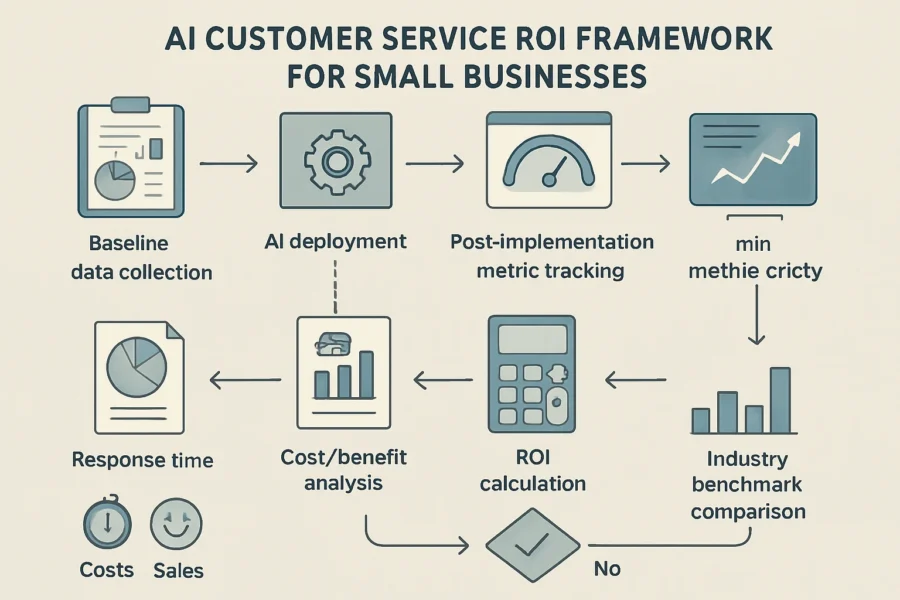
Below is a visual roadmap designed to help small business owners connect each stage of AI customer service ROI measurement, from initial benchmarking to final interpretation. This framework is intended for hands-on decision-making—enabling you to identify where you are in the process and what to prioritize next.
By visualizing the entire journey, business leaders can better communicate priorities and progress across teams. The framework’s stepwise approach also helps clarify dependencies between stages, such as the importance of robust baseline data for drawing meaningful post-implementation comparisons. Consider customizing the infographic with your company’s specific metrics, touchpoints, and decision criteria to transform it into a living reference for ongoing optimization. Regularly updating the visual summary as new data is collected ensures everyone remains aligned and aware of both expected outcomes and areas requiring attention. Moreover, the visual format can simplify complex discussions with stakeholders by breaking down ROI analysis into actionable, digestible components.
ROI Framework Flowchart
- 1. Baseline Data Collection
Start by recording pre-AI metrics: average first response time, resolution time, ticket volume, support costs, and customer satisfaction scores. Segregate by human vs. automated channels where possible. - 2. AI Solution Deployment
Implement your chosen AI tool (such as a chatbot or ticket automation). Document integration points—website, helpdesk—and note any changes to staffing or workflows to ensure accurate comparison later. - 3. Post-Deployment Metric Tracking
After a defined period, re-measure the same metrics. Segment outcomes by AI-handled and human-handled tickets. Pay attention to any shifts in customer satisfaction, cost per resolved ticket, or sales conversion rates traced to AI-handled interactions. - 4. Cost and Benefit Calculation
Compile all costs: software fees, implementation, training, and ongoing support. Weigh these against quantifiable benefits—documented reductions in response/resolution times, customer service cost reduction, and uplift in sales attributed to faster or round-the-clock service. - 5. ROI Formula Application
Apply the standard formula:ROI = (Total Quantifiable Benefits - Total AI Costs) / Total AI Costs. Ensure benefits and costs are calculated over the same period for accuracy. - 6. Benchmark & Contextualize
Compare your results to relevant industry benchmarks. For instance, recent findings show small businesses using AI see up to 41.56% improvement in first response time and $3.50–$8 return per $1 spent, but always contextualize against your business model and support complexity. - 7. Interpretation & Decision Points
Assess whether observed improvements align with your core goals—cost savings, customer experience, or sales growth. Decide whether to expand, adjust, or reconsider your AI deployment based on measurable outcomes, not assumptions.
Key Metric Relationships
- First Response Time & Resolution Time are leading indicators of both customer satisfaction and operational efficiency, directly impacting support costs and potential sales conversions.
- Support Ticket Volume trends may reveal whether AI deflects repetitive queries or inadvertently increases contact rates due to confusion—requiring regular review.
- Customer Satisfaction Scores should be interpreted in the context of issue complexity; improvements in simple query satisfaction may occur alongside unchanged scores for nuanced support.
- Sales Conversion Rates may rise when AI provides instant answers, but only if handoffs for complex needs are seamless. Track the sales funnel step-by-step to identify AI’s true impact.
- Cost per Resolved Ticket reflects both direct savings and hidden costs such as integration maintenance. Use this metric to evaluate true efficiency gains.
Common Decision Forks
- If AI delivers faster responses but customer satisfaction drops: Review conversation flows and escalation triggers; consider hybrid human-AI support for complex issues.
- If cost savings appear but sales conversion stagnates: Re-examine how AI interacts at key sales touchpoints and whether handoffs to sales staff are timely.
- If post-deployment metrics are inconclusive: Extend measurement period, segment by issue type, and validate data quality before making large-scale changes.
How to Use This Framework
Pin this framework at your team’s analytics dashboard or project workspace. Use it to guide quarterly ROI reviews, avoid common measurement errors, and facilitate transparent discussions with vendors or consultants. For practical AI automation ideas tailored to small business workflows, see our AI automation examples for small businesses.
Key Takeaways
Actionable Insights for Small Business Decision-Makers
- ROI of AI customer service for small businesses is multi-dimensional: Industry benchmarks show leading small firms report $3.50–$8 returned for every $1 spent on AI support, but results vary by implementation and measurement discipline. ROI is not just about saving money—it requires tracking both direct and indirect business impacts. Consider not only immediate cost reductions, but also gains in customer retention, staff productivity, and brand reputation, which may take time to materialize. Variability between industries and customer bases means a tailored approach to measurement is crucial for accurate ROI assessment.
- Cost savings must be measured against real baseline data: Average industry data (e.g., 41.56% faster first response, 36.39% quicker resolution) provides useful benchmarks, but your business should collect its own pre- and post-AI metrics for support costs, ticket volume, and staff hours to avoid overestimating benefits. Tracking changes over at least one business cycle can help account for seasonal fluctuations and establish realistic expectations for ongoing savings.
- Sales impact is often underestimated without proper attribution: AI chatbots and automations can drive incremental sales by improving response speed and availability. To measure true sales lift, segment conversion rates and lead captures by AI-assisted versus human-only sessions, and attribute revenue using timestamped support logs. Regularly review attribution models to ensure all channels and touchpoints influenced by AI are properly credited, especially as customer journeys evolve.
- Customer satisfaction metrics remain essential: Post-AI gains in CSAT (customer satisfaction), NPS (net promoter score), and resolution rates must be isolated from other website changes. Use consistent question formats and timing before and after AI adoption to ensure valid comparison. Collect qualitative feedback alongside quantitative scores to uncover nuanced impacts on customer perceptions, and monitor for any shifts in complaint categories or escalation rates.
- Frameworks and methods must fit small business realities: Standard ROI calculation (net gain divided by total investment) is valid, but small businesses need simple, sustainable data collection—such as monthly spreadsheets for costs, tickets, and outcomes—rather than complex dashboards or enterprise-level analytics tools. Focus on clarity and repeatability, ensuring that staff can update metrics without specialized training or significant time investment.
- Blending AI and human support often yields the best ROI: Evidence shows small businesses rarely replace human agents entirely; instead, AI takes over repetitive queries, freeing human staff for complex or high-value interactions. This hybrid approach maximizes both efficiency and personalized service. Regularly review which types of cases are best handled by AI, and adjust workflows to optimize the strengths of both AI and your human team as technology and customer needs evolve.
- Avoid common evaluation mistakes: Failing to record baseline data, using only vendor-reported ROI, or ignoring hidden costs (such as integration or maintenance) can skew results. Regularly review your framework and update your calculations as your business and AI toolset evolve. Ensure you account for all ongoing costs, including software updates, staff training, and any downtime during transitions, to avoid underestimating the true investment required.
- Decision triggers must be tied to measurable outcomes: Invest in or scale AI customer service only when key metrics—such as support volume, cost per ticket, and customer satisfaction—demonstrate sustained improvement compared to initial baselines and relevant industry benchmarks. Establish clear thresholds for success (e.g., a 20% reduction in response time or a 10-point CSAT increase) to guide investment decisions and justify scaling efforts.
- Risks and compliance require ongoing attention: AI systems may introduce new risks around customer privacy, accuracy, or escalation. Apply recognized frameworks (such as the NIST AI Risk Management Framework) to identify, monitor, and mitigate risks specific to your operational context and jurisdiction. Regularly audit your systems for compliance with data protection regulations and document your risk management practices to support future reviews or external assessments.
- Iterative measurement supports long-term success: ROI evaluation is not a one-time task. Build regular review cycles (monthly or quarterly) to validate business case assumptions, refine your metrics, and ensure your AI customer service continues to deliver against your business goals. Use insights from these reviews to inform process improvements, staff training, and future technology investments, fostering a culture of continuous improvement.
Practical Next Steps
- Start with your own baseline: Gather current customer service cost, ticket, and satisfaction data before implementing AI.
- Choose 2–4 core metrics—such as first response time, cost per ticket, and CSAT—to track systematically.
- Apply ROI formulas at regular intervals, segmenting AI-assisted from human-only results.
- Benchmark your outcomes against recent industry data to identify strengths and gaps.
- Revisit your decision criteria and risk management process as your business and technology landscape change.
- For further examples of automation strategies tailored to small business, see our AI automation examples for small businesses.
Related Reading
- AI Prompts for Customer Support
- Top AI Chatbot Implementation Mistakes on Small Business Sites
- Legal and Ethical Considerations for AI Customer Service in Small Business
FAQ
What is the real ROI of AI customer service for small businesses?
The actual return on investment (ROI) for AI customer service in small businesses is typically driven by a blend of cost savings, increased sales, and improved customer satisfaction. According to industry benchmarks, average returns can reach $3.50–$8 for every $1 spent, but the most relevant ROI comes from matching these outcomes to specific business goals. Small businesses often see ROI grow over time as AI solutions are better integrated and support more of the customer journey.
Which metrics best capture the impact of AI on customer service?
The most insightful metrics focus on the end-to-end customer experience and operational efficiency. These include First Response Time, Resolution Time, volume of support tickets handled by AI versus humans, customer satisfaction scores (such as CSAT or NPS), and sales conversion rates directly attributable to AI interactions. Tracking these metrics before and after AI implementation, and segmenting by support channel, yields the clearest picture of impact.
How can small businesses calculate the ROI of AI chatbots or assistants?
To calculate ROI, first estimate all costs related to AI (setup, subscription, training, integration, and ongoing management). Next, measure tangible benefits such as reduced staff hours, increased resolved tickets, higher sales conversion, and improved satisfaction scores. Apply a standard ROI formula: ROI = (Total Benefits – Total Costs) / Total Costs. For accuracy, use only data segmented by AI-handled versus human-handled interactions and factor in any changes in business KPIs after adoption.
What are the common pitfalls in evaluating AI customer service ROI?
Common mistakes include tracking only headline cost savings while ignoring indirect benefits or hidden costs (such as retraining staff or integration delays), relying on vendor-supplied metrics rather than business-owned data, and failing to collect baseline measurements before deploying AI. Another frequent issue is misattributing improvements to AI when other operational changes occurred simultaneously. To avoid these, use a segmented, before-and-after approach and tie metrics directly to business outcomes.
How does AI customer service compare to traditional human support?
AI customer service excels at handling high volumes of routine requests, enabling faster response and resolution times—benchmarked at 41.56% and 36.39% improvements, respectively, in some deployments. Traditional human support remains superior for nuanced, complex, or emotionally sensitive issues. For most small businesses, the best results come from a hybrid model that combines AI’s efficiency with human expertise, rather than replacing one with the other.
When should a small business invest in or scale AI customer service?
Investment or scaling is most justified when support ticket volumes are consistently high, customer wait times impact satisfaction, or operational costs outweigh the benefits of manual handling. Businesses should also consider AI when seeking to extend support hours or languages without proportional increases in staff. However, scaling should be paced with regular ROI reviews to ensure measurable improvements align with core business objectives.
What steps help ensure ongoing AI customer service ROI?
Maintaining strong ROI requires ongoing metric tracking, periodic benchmarking against industry data, and continuous refinement of AI workflows. Regularly retraining both AI models and human staff helps adapt to changing customer needs. Small businesses should also review integration points with sales and marketing systems to ensure AI-driven conversations translate into measurable business outcomes. Periodic risk assessments further safeguard against unanticipated costs or compliance issues.
Conclusion
Measuring the ROI of AI customer service in a small business context is not a one-time calculation but an ongoing process that needs to be integrated into regular business reviews. By treating AI support as a dynamic operational investment, owners can respond to shifting customer expectations, changes in support volume, and evolving business goals without relying on static or vendor-driven metrics.
The most effective next step is to formalize a regular review cycle—monthly or quarterly—where your team brings together segmented AI and human customer service data, compares it against industry benchmarks, and directly connects these results to recent business decisions. This habit transforms sporadic analysis into a discipline, allowing smarter resource allocation, faster detection of ROI trends, and clearer identification of underperforming areas or unexpected gains.
To make this sustainable, automate as much of the data collection and reporting as possible using your website’s analytics tools and support platform exports. Assign specific responsibility for ROI reporting to a named team member, and include at least one decision-maker in each review session. This builds accountability and ensures that insights drive real business action rather than remaining as unused statistics.
As your metrics and benchmarks mature, use each review to set concrete targets—such as reducing first response time by another 10%, or achieving a specific sales conversion rate from AI-assisted chats. If you encounter persistent obstacles or see inconsistent results, revisit your choice of metrics or review your AI-human handoff process rather than assuming the technology is at fault.
Embedding this cycle into your business operations will help you maximize the return from AI customer service, adapt quickly to change, and ensure that every investment is guided by transparent, actionable evidence. Over time, this approach also assists in justifying further technology upgrades or expanding AI use, since you’ll possess a clear record of impact and improvement. As your business grows, these habits will help scale customer support efficiently while maintaining a high standard of service quality and responsiveness.