


Introduction
AI customer service tools, like chatbots and automated helpdesks, are transforming how small businesses interact with customers. However, leveraging these technologies introduces both legal obligations and ethical dilemmas that can be complex to navigate. Small business owners and managers must understand not only which laws apply to AI-powered customer service, but also how to build trust with customers by addressing transparency, consent, and data protection. Additionally, the fast pace of AI innovation means that regulatory guidance may evolve, making it crucial to stay informed about changes that could affect business practices. Ignoring these responsibilities can result in reputational harm or legal penalties, even for small enterprises.
This article tackles the legal and ethical considerations for AI customer service in small business, separating common myths from fact and clarifying where legal requirements end and ethical best practices begin. You will find actionable answers to questions about compliance with privacy regulations such as GDPR, practical steps for protecting customer data, and real-world strategies for ensuring transparency when customers interact with AI systems. The guide also highlights how ultimate responsibility for AI compliance rests with the business itself, not just the AI vendor.
By the end, you’ll have a clear, step-by-step compliance checklist, a myth-versus-fact breakdown to inform your decisions, and a decision support framework tailored to the realities and constraints of small business. Whether you are just starting with AI customer service or want to improve your current setup, this resource will help you confidently reduce risk, meet your obligations, and strengthen customer trust in your AI solutions.

Introduction: Why Legal and Ethical Considerations Matter
Artificial intelligence (AI) is reshaping customer service for small businesses by making advanced automation available at an affordable scale. Tools such as chatbots and automated helpdesk assistants are now within reach for companies with limited IT budgets, enabling them to provide faster responses and improved customer experiences. However, as AI becomes more accessible, the risks associated with its use can be underestimated—especially where legal compliance and ethical integrity are concerned.
Resource Limitations Can Lead to Overlooked Risks
Unlike large enterprises with dedicated compliance teams, small business owners often juggle multiple roles, leaving less time and expertise for understanding the legal and ethical landscape of AI customer service. This reality increases the likelihood that critical requirements—such as data privacy, transparency, and consent—are inadvertently missed or implemented only partially. Even when AI solutions offer built-in compliance features, these are rarely exhaustive. The ultimate responsibility for legal and ethical compliance rests with the business adopting the technology, not the vendor.
Additionally, many small businesses may lack access to ongoing legal guidance or training about evolving regulations. This can create gaps in understanding new legal precedents, updates to privacy legislation, or sector-specific standards. Without dedicated resources, small businesses are also more likely to depend heavily on vendor claims about compliance, which may not address every risk relevant to their unique operations or customer base. A proactive approach, including regular review of internal policies and seeking external advice when needed, helps ensure that compliance is not left to chance.
Non-Compliance: The Stakes for Small Businesses
Failure to comply with data protection and privacy laws, such as the General Data Protection Regulation (GDPR) for EU residents, can have serious consequences. Legal penalties may include fines and mandatory corrective actions. Beyond legal action, reputational damage can disrupt customer relationships and reduce trust, potentially causing long-term business harm that far outweighs any short-term cost savings from rapid AI adoption. Customers are increasingly aware of how their data is collected and used, and expect clarity about when they are interacting with an AI rather than a human.
Why Ethics Go Beyond the Law
Legal compliance is not the only concern. Ethical issues—including algorithmic bias, lack of human oversight, and inadequate consent mechanisms—can impact customer satisfaction and trust even when no laws are broken. Small businesses may face unique challenges in addressing these risks, such as limited access to unbiased training data or technical expertise to audit AI behavior. However, proactively considering ethical risks can serve as a competitive advantage, helping to build a reputation for transparency and fairness in customer interactions.
Clarifying Obligations and Setting Priorities
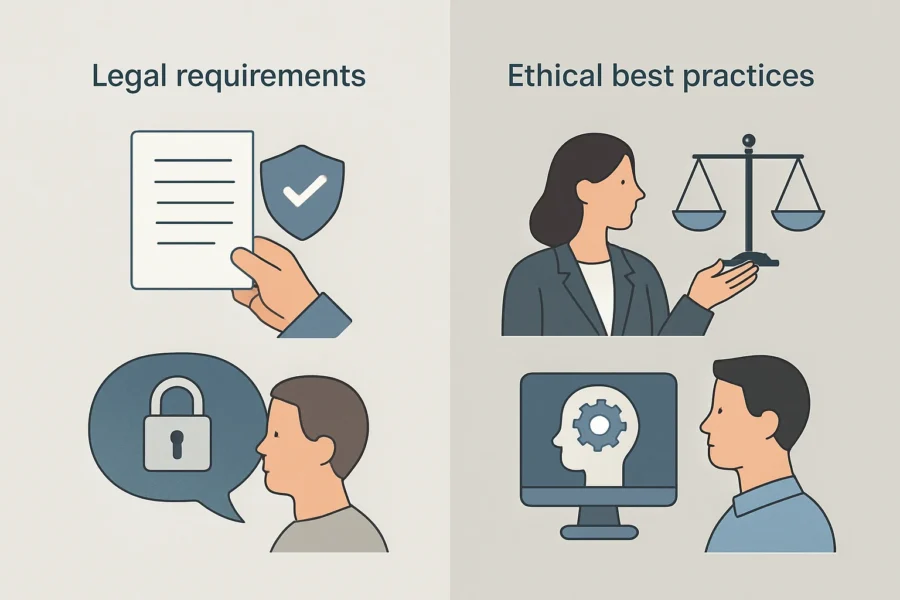
It is essential for decision-makers to separate legal obligations from ethical best practices. Legal requirements, such as providing clear privacy policies and obtaining customer consent, are enforceable and non-negotiable. Ethical practices, like regularly reviewing AI decision-making for fairness or offering customers the option to escalate to a human, support legal compliance and can safeguard against unforeseen pitfalls. By establishing clear internal processes and staying informed about relevant laws and ethical standards, small businesses can minimize risk and maintain customer trust as they adopt AI-driven solutions.

Myth Versus Fact: Legal and Ethical Realities of AI Customer Service
AI Customer Service: Separating Common Myths from Legal and Ethical Facts
Misconceptions about AI customer service compliance can expose small businesses to legal and reputational harm. The table below clarifies what is mandatory, what is only best practice, and which myths may risk non-compliance. Many small business owners assume compliance is straightforward, yet regulations are evolving rapidly and enforcement has increased. Understanding these differences is essential for risk reduction and for building customer trust. By debunking prevalent myths, businesses can avoid costly penalties, data breaches, and loss of reputation. Proactive compliance also positions businesses more competitively as consumer expectations around privacy and ethics continue to grow.
| Myth | Fact | What Small Businesses Must Do |
|---|---|---|
| All AI customer service tools are compliant out-of-the-box. | Many tools lack full GDPR or local data protection compliance. Features may help, but responsibility stays with the business. | Audit every AI tool for compliance. Check privacy, security, and consent features before deployment. |
| Having a privacy policy is enough to meet legal requirements. | A written privacy policy is only the first step. True compliance requires practical implementation—actual data handling and consent processes must match the policy. See example privacy policy. |
Regularly review and update policies. Train staff and configure AI systems to comply in practice. |
| AI bias is only a technical challenge, not a compliance issue. | Bias in AI customer service can violate anti-discrimination laws and cause reputational damage. Legal frameworks increasingly address biased automated decisions. | Test AI outputs for bias. Document mitigation steps. Allow human review and correction in sensitive cases. |
| Customers do not need to know when they are interacting with AI. | In some jurisdictions, transparency is a legal requirement. Ethically, clear disclosure builds trust and supports informed consent. | Clearly label AI interactions. Disclose data usage and provide opt-out where possible. |
| If the vendor claims compliance, the business is not liable. | Responsibility for compliance always remains with the business that collects and processes customer data, regardless of vendor assurances. | Demand written compliance documentation from vendors, but perform your own due diligence and risk assessment. |
Practical Implementation: Beyond Written Policies
Small businesses must move compliance from policy documents into active processes. For example, publishing a privacy policy (such as this sample) is not sufficient unless internal practices, staff training, and AI system settings all enforce the same rules. Periodic audits help ensure what is stated matches daily operations. In practice, this means monitoring data flows, ensuring real-time consent management, and providing clear procedures for data breaches. Documented procedures and evidence of compliance activities can help demonstrate accountability during regulatory reviews or customer inquiries.
Addressing AI Bias: A Legal and Ethical Imperative
Unchecked AI bias can trigger legal complaints, especially if automated decisions affect customer outcomes. Small businesses should routinely test AI systems for bias, document outcomes, and provide clear escalation channels for customers to dispute or clarify responses. This approach not only reduces legal exposure but also strengthens reputation and customer trust. Regularly updating training data and involving diverse stakeholders in system reviews can further minimize the risk of perpetuating bias, ensuring fairer outcomes for all users.
Transparency: When Disclosure Is Mandatory
New regulations in some regions require businesses to notify customers when AI is involved in communication or decision-making. Even where not yet required by law, disclosing AI use and data handling practices supports ethical standards and can prevent misunderstandings. Transparent practices help small businesses build lasting relationships with customers based on trust and informed consent. Clear communication around AI involvement and data usage also empowers customers to make informed choices and improves the overall customer experience.
Pros and Cons of AI Customer Service in Small Business
If your customer base includes local clients, aligning your AI compliance principles with Local SEO for WordPress Websites can increase transparency and trust.
Advantages: Efficiency, Availability, and Growth
- Cost Savings: Deploying AI in customer service can reduce labor costs by automating repetitive tasks, allowing small teams to handle more inquiries without hiring additional staff. This increases operational efficiency, especially during peak periods.
- 24/7 Availability: AI-powered chatbots and helpdesk assistants enable businesses to support customers outside regular office hours. This responsiveness can help meet customer expectations in an always-connected marketplace and reduce missed sales or support opportunities overnight or on weekends.
- Faster Response Times: AI tools can instantly acknowledge customer requests, route tickets, and answer common questions, cutting wait times and improving perceived service quality. This can free human staff to focus on complex or sensitive issues requiring judgment.
- Scalable Support: As customer volume rises, AI systems can handle more requests in parallel without sacrificing speed, letting small businesses adapt to growth or seasonal surges without immediate scaling of staff.
- Consistent Interactions: AI-powered systems deliver standardized responses, reducing the risk of human error or inconsistent information. This consistency helps ensure every customer receives accurate, up-to-date answers, which can contribute to building a reliable brand reputation. Additionally, AI can gather and analyze customer feedback at scale, helping identify common issues and opportunities for service improvements more quickly than manual processes.
Disadvantages: Legal, Ethical, and Trust Risks
- Potential Privacy Violations: AI systems often process sensitive customer data. Without robust privacy controls and regular audits, there is risk of mishandling personal information, exposing businesses to regulatory penalties and customer complaints.
- Customer Distrust: Some customers may feel uncomfortable interacting with automated systems, especially if it is unclear whether they are communicating with a human or AI. Lack of transparency can erode trust and deter repeat business.
- Regulatory Risks: Legal requirements around data protection (such as GDPR) apply to businesses of all sizes. Small businesses must ensure that AI tools comply with consent, data storage, and reporting obligations, regardless of vendor assurances. Non-compliance can result in fines or forced changes to operations.
- AI Bias and Reduced Personal Touch: AI models can reflect or amplify biases present in data, potentially leading to unfair or inconsistent treatment of customers. Automated responses may also fail to recognize emotional cues or context, undermining the personal experience valued by many small business clients.
- Technical Challenges and Maintenance: Implementing AI requires initial investment in setup and ongoing maintenance. Small businesses may face challenges integrating AI with legacy systems, and technical errors or outages can disrupt service. Continuous training and monitoring are necessary to ensure AI remains accurate and effective as products, policies, and customer needs evolve.
Weighing the Trade-offs
For small businesses, the decision to implement AI customer service is rarely all-or-nothing. Optimizing benefits means pairing automation with clear policies, transparent communication, and regular monitoring. Legal compliance cannot be fully outsourced to AI vendors: businesses remain responsible for privacy, consent, and fairness in every customer interaction.
To balance efficiency with trust, consider a hybrid approach: use AI for routine requests but ensure easy escalation to human staff for complex or sensitive issues. Regularly review AI performance for errors or bias, and update privacy processes as regulations evolve. By treating AI as a support tool—not a total replacement—small businesses can harness its strengths while maintaining compliance and customer loyalty. Evaluate your team’s technical capacity and budget for ongoing AI management, and ensure customers have clear channels for feedback and resolution if AI interactions fall short.
Illustrative Scenario: A Small Retailer Implements AI Chatbots
Deploying a Chatbot: The Initial Setup
Imagine a small online retailer seeking to improve its response times by integrating an AI chatbot for handling order-related inquiries. The business chooses a well-known chatbot platform that promises quick installation and a user-friendly interface, allowing customers to check order status, track deliveries, and ask about returns directly through the website. The integration process is straightforward: the retailer customizes the chatbot with frequently asked questions and branding, aiming to reduce the burden on human support staff. During setup, the business relies on default platform configurations, assuming these settings align with relevant privacy and data protection standards. However, no dedicated review of the chatbot’s data collection and storage practices takes place prior to launch.
Privacy Notice: A Partial Compliance Step
As part of the launch, the retailer adds a privacy notice to its website. The notice outlines that customer data may be processed by the chatbot and refers to the main privacy policy. However, the chatbot interface does not prompt customers for explicit consent prior to collecting or analyzing their queries and order details. The business assumes that the general site-wide privacy notice is sufficient, overlooking the difference between passive policy display and active consent—especially relevant if customers are in jurisdictions with strict data protection laws like the GDPR. Without an explicit consent mechanism within the chatbot itself, users may not be adequately informed at the point of data collection, which raises compliance concerns. Additionally, the privacy notice does not specify how chatbot interactions are stored, for how long, or how customers can request data deletion, leaving customers with limited transparency regarding their rights.
Customer Data Deletion Request: The Process Gap
Several weeks after launch, a customer contacts support with a request to have all their previous chatbot interactions and related personal data deleted. The business owner realizes there is no clear process for identifying, extracting, or erasing chatbot-specific data. The chatbot vendor offers some data export tools, but documentation is limited and does not address how to verify the data subject’s identity or how to handle partial deletion requests. The retailer is uncertain whether the chatbot logs are stored locally, in the cloud, or by the vendor, making it challenging to trace and verify the scope of data held. This lack of clarity delays the response and increases the risk of non-compliance, as the business cannot confidently fulfill the customer’s request within required legal timeframes.
Facing a Complaint: Urgent Compliance Review
The customer escalates their concern, filing a complaint about the handling of their data and the lack of a visible consent mechanism. The retailer is forced to conduct an urgent review of its AI customer service compliance. Key questions arise: Has explicit consent been obtained, or is legitimate interest being wrongly assumed? Are data retention policies clear and enforced for chatbot logs? Is there a documented procedure for fulfilling data subject access and deletion requests? The review uncovers that responsibilities for data governance are not clearly assigned, and that training for staff on privacy and AI-specific risks has not been conducted. These gaps highlight how quickly a well-intentioned digital upgrade can expose a business to regulatory and reputational threats if compliance is not fully integrated into AI deployment.
Decision Points and Practical Lessons
- Active Consent: Relying solely on a privacy notice may not meet legal standards for consent, especially in jurisdictions that require opt-in for personal data processing by automated tools.
- Data Subject Rights: Without clear mechanisms for locating and deleting chatbot data, fulfilling customer rights becomes operationally difficult and legally risky.
- Vendor Limitations: While chatbot platforms may offer some compliance tools, ultimate responsibility for legal and ethical handling of customer data remains with the business—not the vendor.
- Policy Enforcement: Compliance is not achieved by posting policies alone; businesses must implement, test, and update procedures for all data-handling scenarios AI may introduce.
This scenario highlights how practical compliance with legal and ethical standards for AI customer service requires more than technical setup or generic policy statements. Small businesses must proactively design and regularly review their data protection practices to avoid complaints, legal exposure, and reputational harm.
Comparison Table: Legal vs. Ethical Issues in AI Customer Service
Distinguishing Mandated Compliance from Best-Practice Ethics
For small businesses adopting AI customer service, it is crucial to separate requirements mandated by law from those considered ethical best practices. The following table clarifies which responsibilities are legally binding, which are guided by ethical standards, and which fall under both. This enables business owners to prioritize immediate compliance while planning for higher ethical trust and customer expectations.
| Issue | Mandated by Law | Recommended by Ethics | Key Implementation Details |
|---|---|---|---|
| Privacy Policy | Yes (if personal data is collected or processed) See example |
Yes | Publish a clear, accessible privacy policy detailing data collection, use, and sharing. Keep it updated and aligned with actual practices. |
| Data Consent | Yes (where required, e.g., under GDPR for EU citizens) | Yes | Implement explicit consent mechanisms before collecting personal data. Ensure users can withdraw consent easily. |
| Transparency (AI Disclosure) | Increasingly required (some jurisdictions mandate disclosure when interacting with AI) | Yes | Inform customers when AI is used in interactions and explain what data is collected and how it is used. |
| Bias Mitigation | Sometimes (if discrimination laws apply; varies by region) | Yes | Regularly audit AI outputs for bias, especially where decisions may affect customer access to services. |
| Human Oversight | No (not universally required) | Yes | Offer escalation to human support, particularly for complex or sensitive issues, to build trust and reduce error consequences. |
| Customer Recourse | Yes (right to access, correct, or delete data under regulations like GDPR) | Yes | Enable customers to submit data access requests and complaints; ensure processes for timely response and remediation. |
Beyond the table, it is important to recognize that legal requirements in AI customer service can change rapidly as new regulations emerge. Laws such as the GDPR in Europe or the CCPA in California establish clear frameworks for privacy, consent, and data handling, but other regions may have different or evolving standards. Ethical recommendations often go further, encouraging businesses to consider the intent behind regulations and the broader impact on customer well-being. For example, regularly updating privacy policies and conducting bias audits—even when not strictly required—can help guard against reputational damage and foster long-term customer loyalty. Additionally, transparency in AI use not only fulfills some legal duties but also shows respect for customer autonomy, a key ethical principle. By understanding and communicating both legal obligations and ethical expectations, small businesses are better positioned to safeguard customer rights, adapt to regulatory shifts, and build a competitive reputation for responsible AI use.
How to Use This Table for Actionable Compliance
Small businesses should treat all legal mandates as non-negotiable and implement them first, starting with a transparent privacy policy and robust consent procedures. Ethical best practices—such as bias auditing and proactive human support—are not always legally required, but they help prevent issues, improve trust, and may soon become regulatory expectations. When vendor platforms offer compliance features, verify that your business’s actual practices match both legal and ethical standards, as ultimate responsibility remains with the business owner. Regular staff training, periodic policy reviews, and a culture of transparency can further strengthen compliance and ethical performance, ensuring your AI customer service meets both current requirements and future expectations.
Actionable How-To Steps for Compliance
Refer to the WordPress Schema Markup Guide to ensure your compliance, privacy, and transparency pages are structured for maximum visibility and legal clarity.
Organizing support and compliance resources using a clear WordPress Internal Linking Strategy can help users and search engines find your AI compliance pages efficiently.
For practical templates on AI-driven customer support communication, see AI Prompts for Customer Support.
Stepwise Checklist for Small Business AI Customer Service Compliance
- Map Data Flows: Conduct a detailed review of every customer touchpoint where AI tools (such as chatbots or virtual assistants) access, store, or process personal data. Document which data fields are collected, where they are stored, how long they are retained, and who has access. Use this mapping to identify exposure to GDPR or local data protection laws, and to uncover any unintentional data transfers to third parties or external vendors. Additionally, update your data flow documentation whenever new AI features are introduced or significant changes occur. This proactive approach helps ensure ongoing compliance and readiness for regulatory inquiries or audits.
- Update Privacy Policies for AI Use: Ensure your privacy policy explicitly mentions all AI-driven customer interactions and describes the types of data the AI collects, the purpose of processing, and any sharing with third parties. This is not just a one-time edit—update the policy whenever AI capabilities change, as required under GDPR. For guidance, review the structure and transparency of existing privacy statements such as this example. Consider adding a dedicated section on automated decision-making and profiling if your AI systems affect customer outcomes. Make your policy easily accessible on your website and notify customers of significant updates to maintain transparency.
- Obtain Explicit Consent with Clear Opt-In Mechanisms: Implement clear, granular opt-in consent forms for any AI feature that processes personal or sensitive data. Avoid pre-ticked boxes. Present customers with unambiguous choices before activating AI features, and record consent for audit purposes. Consent must be as easy to withdraw as it is to give, supporting both compliance and customer trust. Routinely review your consent mechanisms to ensure they remain legally valid and function as intended across all platforms and devices.
- Train Staff on AI Limitations and Escalation: All customer-facing staff must understand the scope and boundaries of your AI systems. Provide training on how to recognize when a conversation requires escalation to a human agent, especially for complex, sensitive, or unresolved issues. Establish and document a clear protocol for these handovers to ensure regulatory and ethical standards are met. Refresh training regularly and update materials to reflect any AI upgrades or new compliance requirements.
- Regularly Review and Test AI for Bias and Accuracy: Schedule periodic audits of your AI system’s outputs. Analyze a sample of interactions for evidence of bias, misclassification, or accuracy failures that could affect customer outcomes or violate anti-discrimination regulations. Adjust AI prompts or retrain models based on findings. For practical prompt guidance, see this resource. Keep a record of tests performed and corrective actions taken to demonstrate accountability if questioned by regulators.
- Provide Transparent Customer Information and Recourse: Clearly communicate to customers when they are interacting with AI, what data is being collected, and the purpose of data use. Offer accessible options for customers to request human support, access or delete their data, and submit complaints regarding AI interactions. Transparency is essential to satisfy both legal disclosure obligations and ethical best practices. Consider publishing a plain-language FAQ covering your AI’s role and customer rights to further support informed user decisions.
Implementation Tips
- Assign a compliance lead—even if part-time—responsible for reviewing AI processes and policy updates.
- Test opt-in mechanisms on real devices to ensure clarity and technical reliability.
- Maintain a log of staff training sessions and customer escalation cases for future audits.
- Document any changes in AI system design or deployment that affect data handling.
- Stay updated on relevant regulations, such as GDPR or local laws, as compliance requirements may evolve with new legislation or guidance.
Visual Summary: AI Customer Service Compliance Framework
Compliance Framework at a Glance
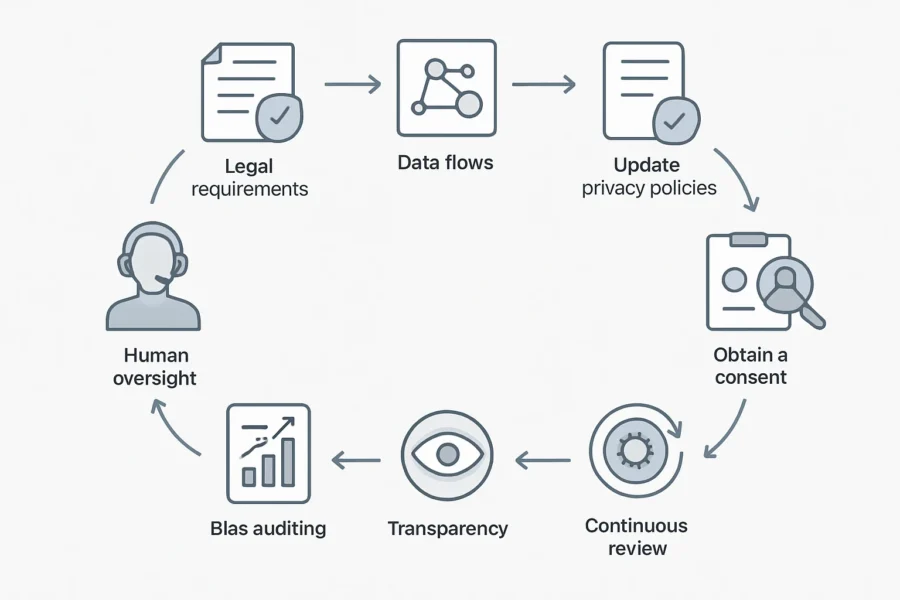
For small businesses deploying AI in customer service, compliance is not a single step but a continuous cycle involving legal, ethical, and operational decisions. The following visual summary outlines a practical, flowchart-based approach that integrates key requirements and recommendations into a unified, actionable process.
This framework is designed to help businesses quickly visualize the major touchpoints where compliance is required and where ongoing monitoring is essential. By representing compliance as an iterative process, it emphasizes the importance of adaptability and responsiveness to both regulatory change and emerging best practices. The goal is to support decision-makers in balancing customer experience with regulatory obligations, reducing risk while maintaining agility. For example, the framework highlights where to embed safeguards such as automated alerts for consent expiration or triggers for human review of sensitive interactions. Visual elements—like flowcharts or diagrams—can also illustrate how responsibilities may be divided among team members, ensuring no critical step is overlooked. Additionally, the framework serves as a communication tool, clarifying to staff and stakeholders how compliance is embedded throughout the customer service lifecycle and not isolated to a single department or phase.
Framework Overview
- Legal Foundation: Begin by identifying all data protection and privacy regulations relevant to your business location(s) and customer base. For example, GDPR applies if you handle personal data of EU citizens.
- Policy Mapping: Catalogue all customer data flows through AI systems. Document what data is collected, its purpose, and storage duration. Map these details to your privacy policies.
- Consent Mechanisms: Before activation, ensure explicit, opt-in consent is gathered from customers for any data collected or processed by AI tools.
- Vendor Assessment: Evaluate AI vendors for built-in compliance features, but confirm their limitations and clarify that your business retains final responsibility for all legal and ethical outcomes.
- Transparency Steps: Clearly disclose when customers are engaging with AI, not a human, and explain how their data will be used, stored, or shared.
- Ongoing Human Oversight: Designate staff to monitor AI interactions, review escalation processes, and intervene when sensitive or ambiguous issues arise.
- Bias and Accuracy Auditing: Regularly audit your AI systems for bias in automated replies and decision-making, updating training data and workflows as needed.
- Documentation and Recourse: Maintain records of all compliance checks, customer consents, and incident responses. Offer clear channels for customers to request data access, correction, or deletion.
- Continuous Review: Schedule regular reviews of AI compliance practices to adapt to changing laws, technology updates, and evolving ethical expectations.
Sample Flowchart (for Illustration)
- Identify legal requirements →
- Map AI data flows →
- Update privacy policy and obtain consent →
- Assess vendor compliance features →
- Implement transparency and customer notification →
- Assign human oversight and escalation procedures →
- Audit for bias and legal adherence →
- Document actions and enable customer recourse →
- Review and update regularly
The sample flowchart can be adapted for different business sizes or regulatory environments by adding more detailed subprocesses or conditional steps. For instance, businesses serving multiple jurisdictions might include a decision branch for region-specific compliance, while those using multiple AI vendors could visualize parallel assessment workflows. The visual summary is intended as a living resource—one that grows with your business, can be updated as regulations evolve, and helps onboard new staff to compliance protocols more efficiently.
Implementation Tips
- Assign a compliance lead responsible for documentation and ongoing review.
- Use checklists for each stage to prevent overlooked steps.
- Involve staff in escalation protocols and regular bias audits.
- Communicate compliance measures transparently to customers for enhanced trust.
- Leverage visual tools such as annotated diagrams or dashboards to track compliance status in real time and highlight areas needing attention.
- Periodically review and update all visual materials to reflect new legal requirements or operational changes.
Decision Criteria for Selecting AI Tools
Explore AI automation solutions to compare tools with built-in compliance features.
Transparency in Data Handling: What to Look For
When evaluating AI customer service platforms, scrutinize how each tool addresses transparency around data collection, storage, and processing. Prioritize solutions that provide clear, accessible explanations for end-users about when AI is involved and how their data is used. Look for configurable notification banners, detailed logs of automated actions, and explicit statements about data retention periods. This makes your compliance efforts more robust and helps foster customer trust. Additionally, check whether the platform allows you to easily generate audit reports or export data activity records, which can be crucial during regulatory audits or customer information requests. Platforms that offer clear user-facing policies and disclosures, as well as the ability to display real-time status updates on data processing, can further enhance transparency and demonstrate your brand’s commitment to ethical AI use.
Privacy and Consent Features: Enabling User Control
Select tools that offer built-in consent management. This includes customizable opt-in messages, clear options for users to withdraw consent, and mechanisms for data access or deletion requests. Tools should enable easy integration of consent forms into chat or support flows, and allow you to update consent language as regulations or business practices evolve. These features are critical for aligning with regulations such as GDPR and for demonstrating ongoing respect for customer autonomy. Evaluate whether the platform supports granular consent settings, enabling users to choose which types of data they agree to share or which features they wish to enable. The ability to audit user consent history and generate compliance reports can also be valuable, especially for businesses operating across multiple jurisdictions.
Vendor Support for Compliance Documentation
Assess whether your shortlisted AI vendors supply comprehensive compliance documentation. This should include technical descriptions of data flows, third-party subprocessor lists, security certifications, and sample clauses for your privacy policy. Evaluate if the vendor provides guidance on your legal obligations and offers templates or checklists tailored to small businesses. Reliable documentation streamlines your own compliance review and helps you prepare for audits or customer inquiries. Always remember, however, that while vendors can support, the ultimate legal responsibility remains with your business. It is also beneficial to check if the vendor regularly updates its documentation in response to regulatory changes, and whether they offer customer support or training to help you interpret and implement compliance requirements effectively.
Balancing Cost, Features, and Compliance Risks
Small businesses must weigh the trade-offs between feature sets, subscription costs, and the level of compliance risk they are willing to accept. Some lower-cost tools may lack essential privacy safeguards or detailed audit trails, increasing your exposure to regulatory penalties or reputational harm. Conversely, premium tools with advanced compliance features may stretch your budget, but could reduce long-term risk and administrative burden. Consider not only the initial price but also the potential costs of non-compliance, such as fines or customer attrition. Make risk-aware decisions based on your business’s data practices, regulatory environment, and customer expectations. It can be helpful to project long-term costs, including licensing, maintenance, and any additional resources required for compliance management, to ensure the tool remains sustainable as your business grows.
Action Step: Build a Custom Decision Matrix
To support your selection, create a matrix listing your shortlisted tools against these criteria: transparency, consent management, documentation support, and cost-compliance balance. Score each tool based on your priorities. Involve both technical and non-technical stakeholders to ensure all perspectives are represented. Consider running pilot tests with your top candidates to gather real-world feedback on usability and compliance fit before making a final decision. For more on integrating AI automation responsibly in your business, see this resource.
Key Takeaways
1. Legal Accountability is Not Shared: Small Businesses Hold the Compliance Burden
When integrating AI customer service tools, small business owners remain solely responsible for legal and ethical compliance, regardless of any compliance features advertised by AI vendors. Vendor certifications or claims do not transfer regulatory risk away from the business. This means due diligence on how AI processes and stores customer data is essential before and after deployment. It is important to review relevant regulations, such as the GDPR or CCPA, and consult legal counsel familiar with data protection before finalizing any vendor agreement. This can help identify specific obligations—including data processing, breach notification, and cross-border data transfer requirements—that small businesses must meet, even if the AI vendor is located in a different jurisdiction.
2. Privacy Policies Must Be Updated and Enforced in Practice
It is not enough to display a generic privacy policy. Businesses must specifically describe AI usage and data flows, and ensure that real-world processes—such as customer consent collection and data deletion—match what is stated. Discrepancies between written policy and practice increase the risk of regulatory penalties and customer complaints. Regular policy reviews and staff training are recommended to ensure procedures are consistently followed, and that updates to AI tools trigger timely policy adjustments. This helps maintain legal alignment and builds customer trust.
3. Transparency Requires Proactive Communication and Customer Controls
Transparency extends beyond identifying the use of AI in customer interactions. Small businesses should clearly inform customers about what data is collected, how it is processed, and offer straightforward options for consent, data access, and opting out. Implementing a visible communication channel for customers to question or challenge AI decisions further demonstrates ethical commitment. Proactive FAQs, dedicated contact points, and clear explanations of AI logic can help demystify technology and empower customers to make informed choices about their data and interactions.
4. Bias and Oversight: Regular Auditing Is Crucial
Unchecked AI systems may introduce or perpetuate bias in customer service. Small businesses should implement cyclical reviews of AI decision outputs, document findings, and—where possible—include human oversight for escalated cases. This process should be standardized and assigned to a responsible individual or team, even if resources are limited. Using checklists or simple audit templates can make oversight manageable and help identify patterns of bias or unintended outcomes, supporting both fairness and continuous improvement.
5. Data Minimization and Security Are Ongoing, Not One-Time, Concerns
Minimizing the amount of customer data collected and retained by AI systems is a continuous responsibility. Regularly review AI data requirements, restrict access to sensitive data, and ensure all data transfers—whether to vendors, third parties, or backup systems—are secure and documented. This reduces both legal exposure and the impact of any potential breach. Security measures should be revisited often, including encryption, access logging, and periodic vulnerability assessments, to adapt to evolving threats and protect customer information.
6. Actionable Documentation Supports Both Compliance and Trust
Maintain an ongoing record of decisions, compliance checks, policy updates, and customer consent logs. This documentation is vital for demonstrating good-faith efforts in the event of a regulatory inquiry and can be a trust signal for customers. Make sure documentation is kept up to date as AI features or vendor relationships evolve. Establishing a routine documentation schedule—for example, quarterly reviews—can ensure records remain current and accessible when needed.
7. Continuous Learning and Adaptation Are Required
Laws and best practices for AI customer service are evolving. Assign responsibility for monitoring relevant legal updates, industry guidelines, and technology changes. Adapt policies and processes accordingly, and communicate updates transparently to both staff and customers to sustain compliance and trust. Subscription to regulatory newsletters or participation in industry associations can help businesses stay informed, while internal briefings ensure staff understand their ongoing responsibilities.
Further Reading on AI Implementation
For practical frameworks on selecting and managing AI tools, see our Automation & AI resource.
Limitations
Legal Uncertainty and Evolving Standards
Small businesses face ongoing legal uncertainty because AI-related regulations are still developing in many jurisdictions. Privacy and data protection laws, such as GDPR, may be updated to address new AI-driven risks. This means compliance cannot be treated as a one-time project. Business owners must commit to regular reviews of both legal requirements and their own practices, ensuring readiness for legislative changes that could expand their obligations or introduce new liabilities.
Vendor Promises vs. Real-World Controls
While many AI customer service platforms advertise compliance features, these are rarely a substitute for direct oversight by the small business itself. Platform-provided consent tools or privacy settings may not fully align with the specific legal requirements of your region or industry. Additionally, businesses remain liable if the vendor’s controls are misconfigured or insufficient. Regular verification—such as independent audits or thorough testing of consent flows and data deletion mechanisms—is needed to ensure compliance is not simply assumed based on marketing claims.
Transparency Challenges in Automated Interactions
Communicating to customers that they are interacting with AI, and explaining data usage, can be more complex than anticipated. Automated disclosures within chatbots may be overlooked, misunderstood, or bypassed, especially on fast-moving support channels. Achieving genuine transparency may require multi-layered approaches, such as persistent visual indicators, clear onboarding screens, and easy access to AI usage explanations. Small businesses should monitor for customer confusion or complaints as signals that transparency measures need adjustment.
Bias and Unintended Consequences
Efforts to reduce AI bias often rely on vendor tools or periodic audits, but these measures have limitations. Bias can emerge from the underlying training data, from the way the AI is configured, or from changes made during system updates. Small businesses typically lack the resources for deep technical audits or re-training of models. As a result, some biases or errors may persist undetected. Ongoing monitoring, paired with mechanisms for customers and staff to flag issues, is essential—but may still not catch every problem in real time.
Resource Constraints and Trade-Offs
Implementing robust AI customer service compliance frameworks requires time, money, and expertise that many small businesses do not have in abundance. Choices often involve trade-offs—such as prioritizing certain compliance areas over others or relying on less comprehensive but affordable solutions. These limitations mean that risk cannot be eliminated entirely. Owners should document decisions about resource allocation, so if a problem occurs, it is clear what constraints existed and what steps were chosen within those limits.
Limits of Ethical Best Practices
Ethical guidelines, such as maintaining human oversight and prioritizing fairness, are subject to interpretation and may not be fully enforceable in law. While following best practices builds trust, there is no universal standard or external audit for many ethical expectations. This means businesses must define—and periodically revisit—their own benchmarks for responsible AI use, recognizing that what is considered ethical may evolve alongside customer expectations and industry norms.
A well-planned website content structure for SEO can make your AI compliance resources more accessible and trustworthy to both users and regulators.
FAQ
What privacy laws apply to AI customer service in small businesses?
The specific privacy laws depend on where your customers are located and what data you collect. For example, the General Data Protection Regulation (GDPR) applies if you process personal data of EU residents, regardless of your business’s location. In other regions, local regulations such as the UK’s Data Protection Act or state-level laws like the California Consumer Privacy Act (CCPA) may apply. Always determine which jurisdictions you serve and map your data flows to identify relevant obligations.
How can small businesses ensure AI customer service is transparent?
Transparency requires two key actions: notifying customers when they interact with AI and explaining how their data is processed. Place clear notices on chat interfaces and in your privacy policy, specifying when AI is used and the logic behind major decisions or automated replies. Offer a simple way for customers to request human intervention or clarification about AI-driven outcomes. Regularly review communication channels to verify that disclosures remain accurate as your systems evolve.
What are the main ethical risks of using AI for customer service?
Beyond legal compliance, ethical risks include automated responses that lack empathy, reinforcement of existing biases in training data, and over-reliance on AI without meaningful human oversight. Ethical pitfalls can also arise when AI makes decisions based on incomplete or outdated customer profiles. To address these, institute regular reviews of AI outputs for fairness, and empower staff to override or improve AI-generated responses when needed.
What compliance steps must small businesses take before deploying AI?
Before rollout, conduct a privacy impact assessment to identify and mitigate risks. Update your privacy policy to specify AI use and data handling practices. Secure explicit customer consent if required by law. Verify that your AI vendor’s features support your compliance requirements, but document your own procedures and keep records of all customer-facing disclosures, internal audits, and staff training sessions related to AI use.
How should customer data be protected when using AI systems?
Customer data protection involves more than encryption. Limit data collection to what is necessary, and implement role-based access controls to restrict who within your business can view sensitive information. Regularly review and delete data that is no longer required. If using third-party AI platforms, verify their data retention and deletion policies, and ensure contracts include obligations for secure data handling and breach notifications.
Who is responsible for AI compliance—the vendor or the business?
The business using the AI system is legally responsible for compliance, even if the vendor offers compliance features or guarantees. Vendors can assist by providing tools for consent management or audit trails, but ultimate accountability—including responding to data subject requests or breaches—rests with the business owner. Review vendor contracts for clarity on support and liability, and do not rely solely on marketing claims.
How can small businesses address AI bias in customer interactions?
To tackle bias, periodically audit AI outputs for patterns indicating unfair treatment or stereotyping. Use diverse and representative training data when possible. Solicit feedback from customers and staff to spot subtle issues that automated checks may miss. Document your auditing processes and corrective actions. Consider involving external advisers for independent bias assessments if resources allow.
What are the consequences of non-compliance with data protection laws?
Non-compliance can result in regulatory investigations, fines, mandatory audits, and public disclosure of violations. Legal penalties vary by jurisdiction and law but can be substantial even for small businesses. Beyond financial costs, breaches of trust may damage your reputation and customer relationships. Proactive compliance and transparent communication with customers can help minimize both legal and reputational risks.
Conclusion
Adopting AI customer service in small business is not a one-time task, but a continuous commitment to compliance and trust. After weighing legal and ethical frameworks, the next actionable step is to formalize ongoing monitoring and improvement processes. Assign a staff member or external advisor to routinely review relevant regulations and track updates from your AI vendors regarding privacy and compliance features. This ensures you are alerted to legal changes and that your practices remain current.
To reinforce transparency, consider publishing a clear summary on your website describing how AI is used in customer service, how customer data is processed, and how individuals can exercise their rights. This proactive disclosure not only fulfills many transparency requirements but also builds customer confidence by demonstrating your commitment to responsible AI use.
Document all internal decisions and risk assessments regarding AI customer service. Maintain a record of how compliance steps—such as consent collection, bias audits, and data deletion procedures—are implemented and periodically reviewed. This documentation is invaluable if you ever need to demonstrate due diligence to regulators or clients.
Additionally, regularly update your internal training programs to keep staff informed about evolving AI technologies and compliance obligations. Well-informed employees are better equipped to identify potential risks early, handle customer queries about AI responsibly, and recognize when escalation is necessary. Integrating this training into employee onboarding and ongoing professional development helps build a company culture of accountability and awareness, which supports long-term compliance and enhances overall service quality.
Finally, join industry or regional business groups focused on digital compliance, privacy, or AI ethics. These networks can provide practical updates, peer support, and interpretation of new requirements without the need for expensive legal consultations. By staying active in these communities, your business is better positioned to adapt your AI customer service approach as standards evolve.
For further guidance on integrating automation and AI responsibly in your business, visit our Automation & AI resource for practical tools and implementation support.