
SEO is no longer just about keywords.
Search engines and AI systems are evolving rapidly. Instead of simply matching words, they now seek to understand meaning, relationships and structure. This completely changes how websites should be built and optimized.
If your WordPress website is not machine-readable, context-rich and properly structured, you are already losing visibility—even if the content appears perfectly optimized at first glance.
In this guide, we will look at how modern SEO actually works, why structured data and entity SEO are becoming critical, and what most WordPress websites are still getting completely wrong.
In this guide
- Why SEO is changing faster than most website owners realize
- Why most WordPress websites fail at modern SEO
- What schema markup is and why it matters
- What is entity SEO and why is it important now
- Real-world examples of entity SEO in use
- How Google and AI systems understand websites today
- How AI systems actually use structured data
- SEO is moving from keywords to entities
- What this looks like in practice
- Traditional SEO vs. structured entity SEO
- The hidden problem in most WordPress SEO setups
- Where this problem comes from
- Why we built a different solution
- What actually happens without structure
- Introducing: EntitySchema Pro
- What EntitySchema Pro actually helps you achieve
- Advanced use cases
- Who it is for (and who it is not)
- How it works
- Frequently asked questions
- Common schema SEO mistakes
- Are you ready to turn your website into a structured SEO system?
Why SEO is changing faster than most website owners realise
For years, SEO has been based on keywords, backlinks and content optimisation. These principles are still important — but on their own, they are no longer enough.
Search engines no longer simply match words. They try to understand meaning.
Instead of asking “does this page contain the keyword?”, modern systems ask:
- What does this website represent?
- What services or products are offered?
- How are the pages connected to one another?
- Is the content structured and consistent?
This shift is driven by semantic search, knowledge graphs, and AI systems that interpret content far more deeply than traditional algorithms ever could.
SEO is moving from keywords to meaning, from pages to entities, and from content to structured understanding.
If your website does not clearly communicate structure and context, search engines have to guess for themselves — and guesswork means weaker results.
Here is the problem most websites fail to notice
Everything appears optimized — but the structure is broken.
Why most WordPress websites fail in modern SEO
Despite the vast selection of SEO plugins, most WordPress websites still lack a strong structured foundation.
On the surface, everything may seem optimized. Headings are in place, meta descriptions are present, and content is published regularly. But from a technical perspective, the structure is often incomplete or inconsistent.
- No clear structured data strategy
- Plugins create generic and superficial schema
- Entity relationships between pages are missing
- There is no page-level control
- Weak business and service context
- Inconsistent markup across the website
Most plugins focus on automation — not accuracy. They create “valid” schema, but not necessarily meaningful schema.
The result? Search engines see fragmented information, not a cohesive structure.
Most WordPress websites are easy for people to read but difficult for machines to understand.
What is schema markup and why is it important
Schema markup is a structured data format that helps search engines understand what your content actually means.
Rather than simply reading text, search engines can interpret specific meaning:
- Who you are (organization, brand, person)
- What you offer (services, products)
- What the page represents (article, product, FAQ)
- How everything is connected
The JSON-LD format is typically used for this purpose, adding a machine-readable layer to your content.
Schema is not just for rich snippets or star ratings on Google.
Schema markup is the foundation that enables search engines and AI systems to understand your website as a structured system—not just text.
Without structured data, your website has to rely on interpretation. With it, you provide clarity.
And in today’s SEO, clarity wins.
What Is Entity SEO and Why It Matters Now
Traditional SEO has always focused on keywords—matching search queries to pages that contain similar words.
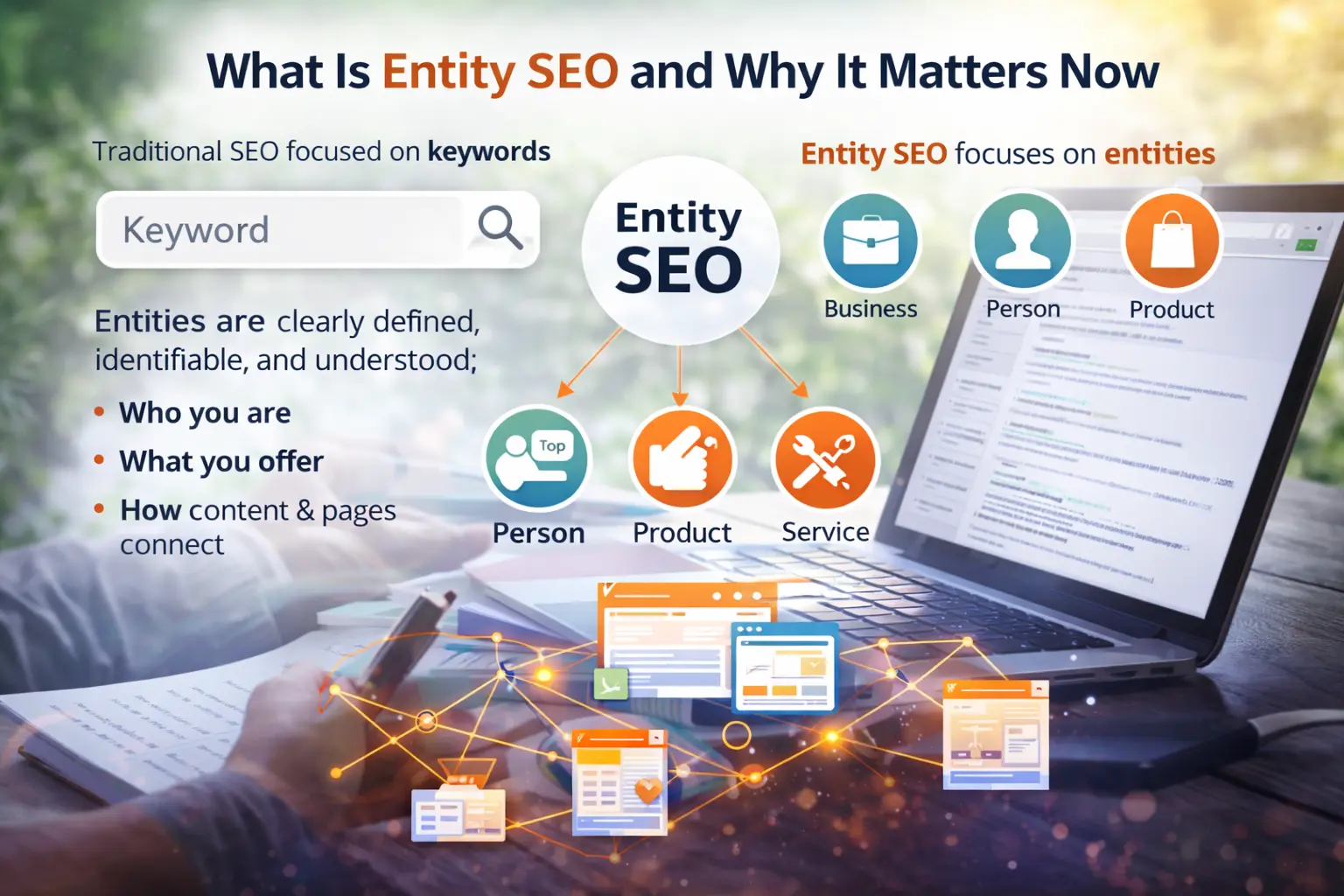
But modern search engines no longer rely solely on keywords. They rely on for entities.
An entity is something that exists independently and can be clearly defined:
- Company
- Person
- Product
- Service
- Topic or concept
Instead of asking “does this page contain the keyword?”, search engines now aim to understand:
- Who you are
- What you offer
- How your pages are connected to one another
- How your content relates to real-world concepts
This is where entity SEO becomes critical. It is not about repeating keywords—it is about creating meaning and structure.
Entity SEO means creating a system of interconnected meanings—not optimising individual pages.
A well-structured website functions like a network. The homepage defines the core entity, subpages expand on it, and the content supports the whole.
The stronger and clearer these connections are, the easier it is for search engines to trust your website.
Real-world examples of entity SEO in action
To understand how powerful entity SEO truly is, we need to move beyond theory and look at how search engines actually interpret structured content.
Imagine two websites offering the same service—web development.
The first website uses traditional SEO:
- Keywords such as “web development service”
- Simple headings and content
- No structured data or connections
The second website uses entity-based SEO:
- Defines itself as an organization
- Links services to specific pages
- Uses structured data to define each service
- Connects all pages through a clear hierarchy
To a person, both websites may appear similar.
But to a search engine, they are completely different.
The first website is content. The second website is a system.
And search engines prefer systems they can understand.
This is where most websites fall short—not because they lack content, but because they lack clarity and structure.
How Google and AI systems understand websites today
Search engines like Google have evolved into sophisticated systems that combine structured data, machine learning, and large-scale knowledge graphs.
They no longer simply index pages — they interpret meaning.
Modern systems rely on three core elements:
- Structured data → defines what it is
- Context → explains how it relates to other elements
- Consistency → confirms trustworthiness across the entire website
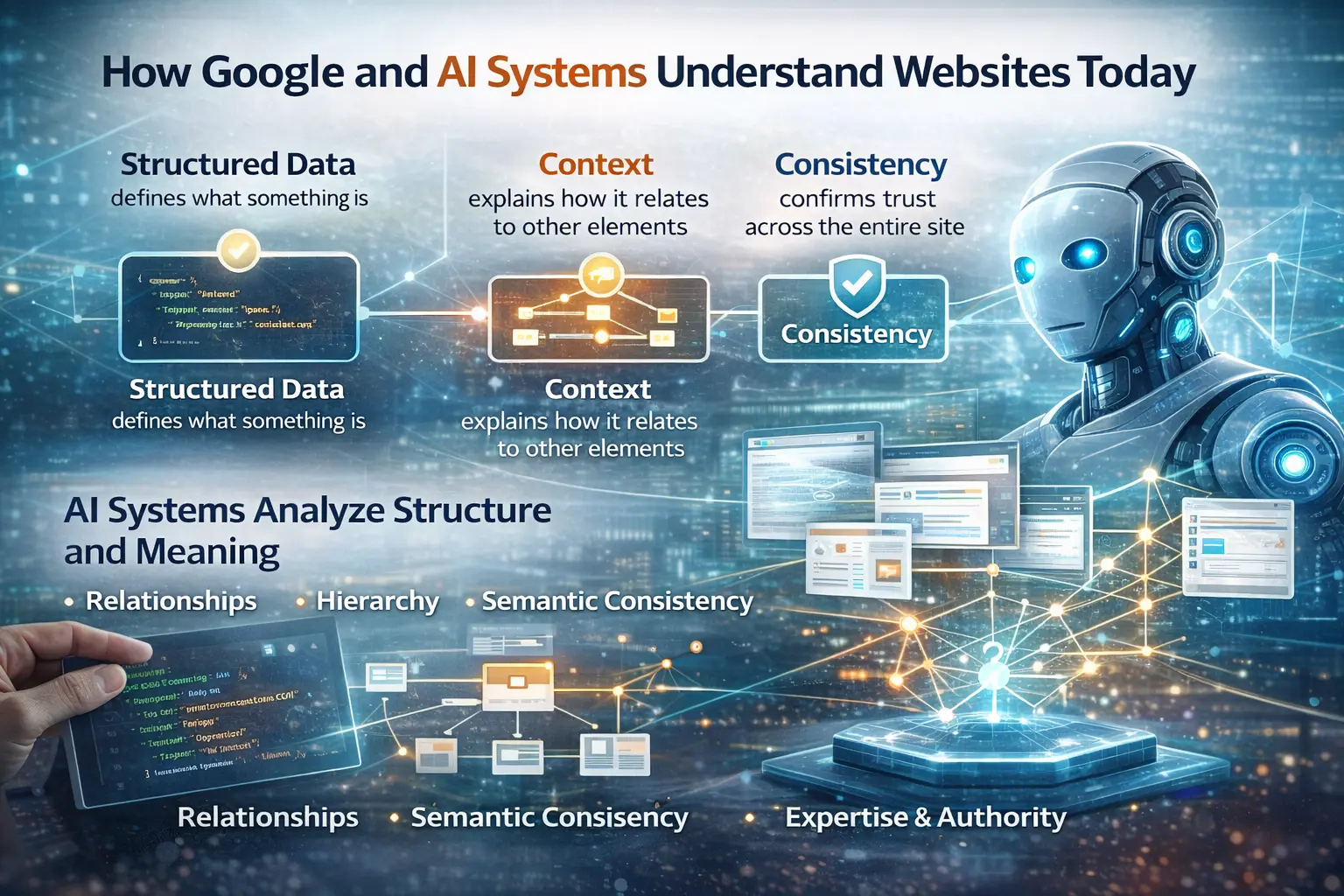
AI systems go even further. They do not just index pages — they seek to understand the structure behind them.
They analyse:
- Relationships between pages
- Content hierarchy
- Semantic consistency
- Signals of expertise and authority
If your content is not clearly structured, AI systems must interpret it — and interpretation creates uncertainty.
Therefore, structured data is no longer an optional addition. It reduces ambiguity and increases trust.
How AI systems actually use structured data
AI systems do not read web pages in the same way people do.
They do not “see the design” or “experience the UX”. They process signals.
When an AI system analyzes a page, it looks for:
- Clear definitions (what is it?)
- Relationships (how is it connected?)
- Consistency (does it align across the entire website?)
Without structured data, AI has to guess.
With structured data, AI can understand.
Structured data acts as a bridge between human-created content and machine understanding.
This is especially important in the era of AI-powered search, where systems generate answers rather than simply displaying links.
If your website is not clearly structured, it becomes invisible in these systems.
SEO is shifting from keywords to entities (from words to meaning)
One of the most important changes in SEO can be summed up in one simple sentence:
“From words → meanings and entities”
Previously, results were primarily influenced by:
- Keyword density
- Exact phrases
- Basic on-page signals
Today, results are influenced by:
- Entity clarity
- Relationships between content
- Context and meaning
- Structured data signals
This completely changes how websites need to be built.
Simply publishing content is no longer enough. Your website must clearly communicate what it is, what it does, and how everything is connected.
This is where structured data becomes a true competitive advantage.
What this looks like in practice
The difference between conventional SEO and structured entity-based SEO becomes especially clear when visualised.
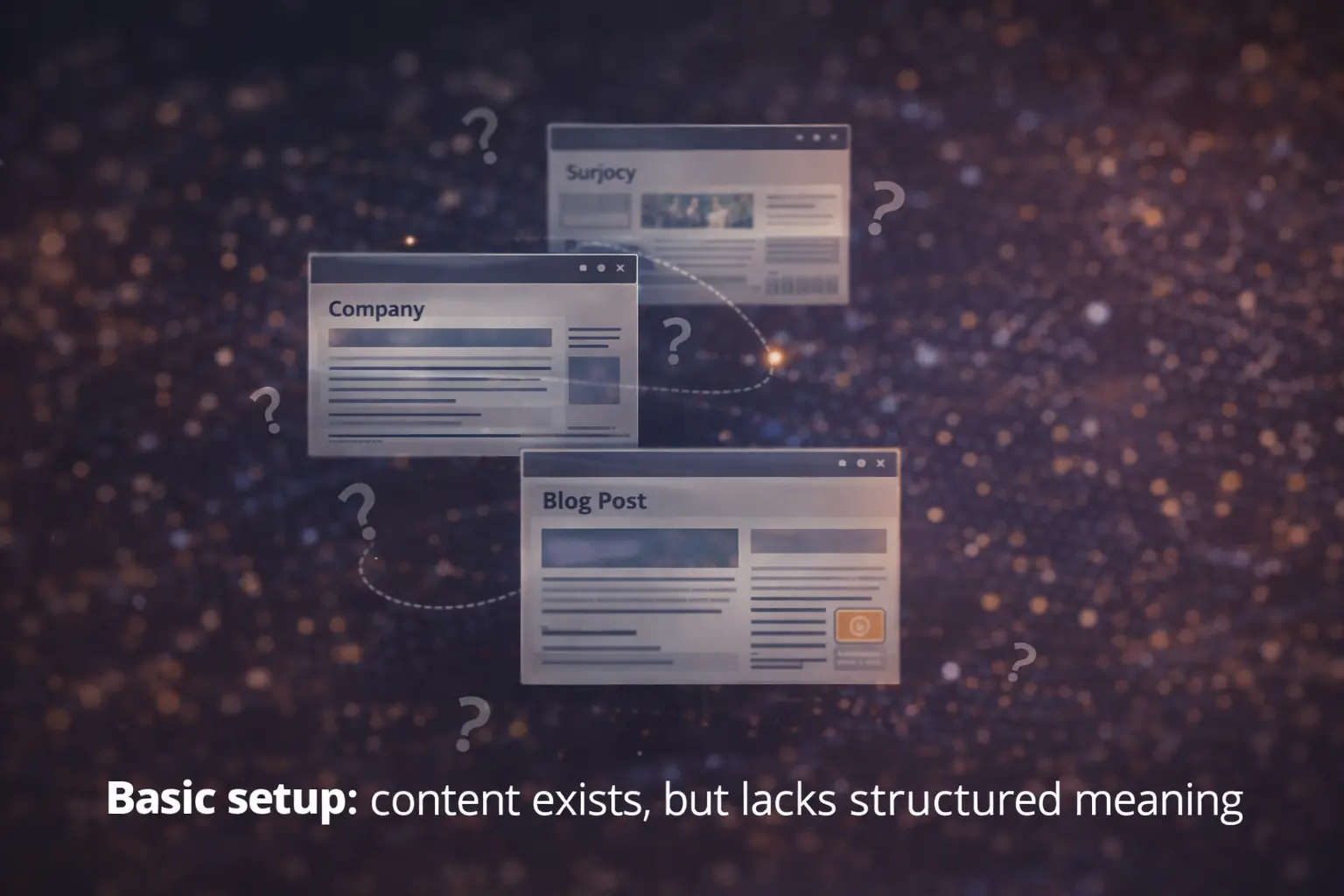

In the first case, search engines rely on text and assumptions.
In the latter case, your website provides clear signals that define exactly what each page represents.
This removes ambiguity and builds trust.
The difference is not merely visual—it directly affects how your website is understood, ranked, and displayed in both search engines and AI systems.
Traditional SEO vs. structured entity SEO: what is the difference?
Not all SEO solutions are created equal. In fact, most WordPress websites fall into three categories: no strategy, simple automated schema, or an advanced entity-based structure.
The difference is not merely technical—it directly affects how your website is understood.
| Feature | No schema | Standard plugin | Entity-based solution |
|---|---|---|---|
| Structured data output | ❌ | ✅ Basic | ✅ Advanced |
| Page-level control | ❌ | ⚠️ Limited | ✅ Full control |
| Entity relationships | ❌ | ❌ | ✅ Connected structure |
| Global + page-level logic | ❌ | ⚠️ Partial | ✅ Unified system |
| AI-readable context | ❌ | ❌ | ✅ Optimized |
| Business clarity | ❌ | ⚠️ General | ✅ Precise |
| Consistency across the website | ❌ | ⚠️ Inconsistent | ✅ Structured |
| Scalability | ❌ | ⚠️ Limited | ✅ High |
The difference is not just whether you have schema — it is whether your website is genuinely understandable.
The hidden problem with most WordPress SEO setups
Most website owners think their SEO is in order because they installed a plugin.
But what actually happens is this:
- Schema is generated automatically
- Fields are filled in using generic information
- Relationships are not defined
- There is no real structure between pages
This creates the illusion of optimization — but not genuine understanding.
Search engines may be able to process data, but they cannot form a clear picture of what your website actually represents.
Having schema is not the same as having meaningful structured data.
This gap is where most websites lose visibility — not because they lack content, but because they lack clarity.
How this gap arises
The problem is not a lack of tools — it is that most tools are built for automation, not precision.
They generate safe, generic outputs designed to “pass validation”, but they do not fully describe your business or content.
This leads to the following problems:
- A flat, disconnected data structure
- No entity hierarchy
- Weak signals for AI systems
- Inconsistent structure across pages
And when your structure is weak, everything else becomes more difficult:
- Harder to rank
- Harder to scale content
- Harder for AI to understand your page
Why we created a different approach
After using structured data across several WordPress projects, one problem kept coming up:
There was no simple way to validate structured data correctly—without having to write everything manually.
Most solutions were either:
- Too simple (automated, generic output)
- Too complex (developer-level configuration)
There was nothing in between.
This gap between simplicity and control was precisely what needed solving.
We did not want to create yet another SEO plugin. We wanted a system that genuinely builds structure.
What actually happens without structure
Let’s take a closer look at what happens on most WordPress websites.
The user installs an SEO plugin.
The plugin generates schema automatically.
Everything seems fine.
But in reality:
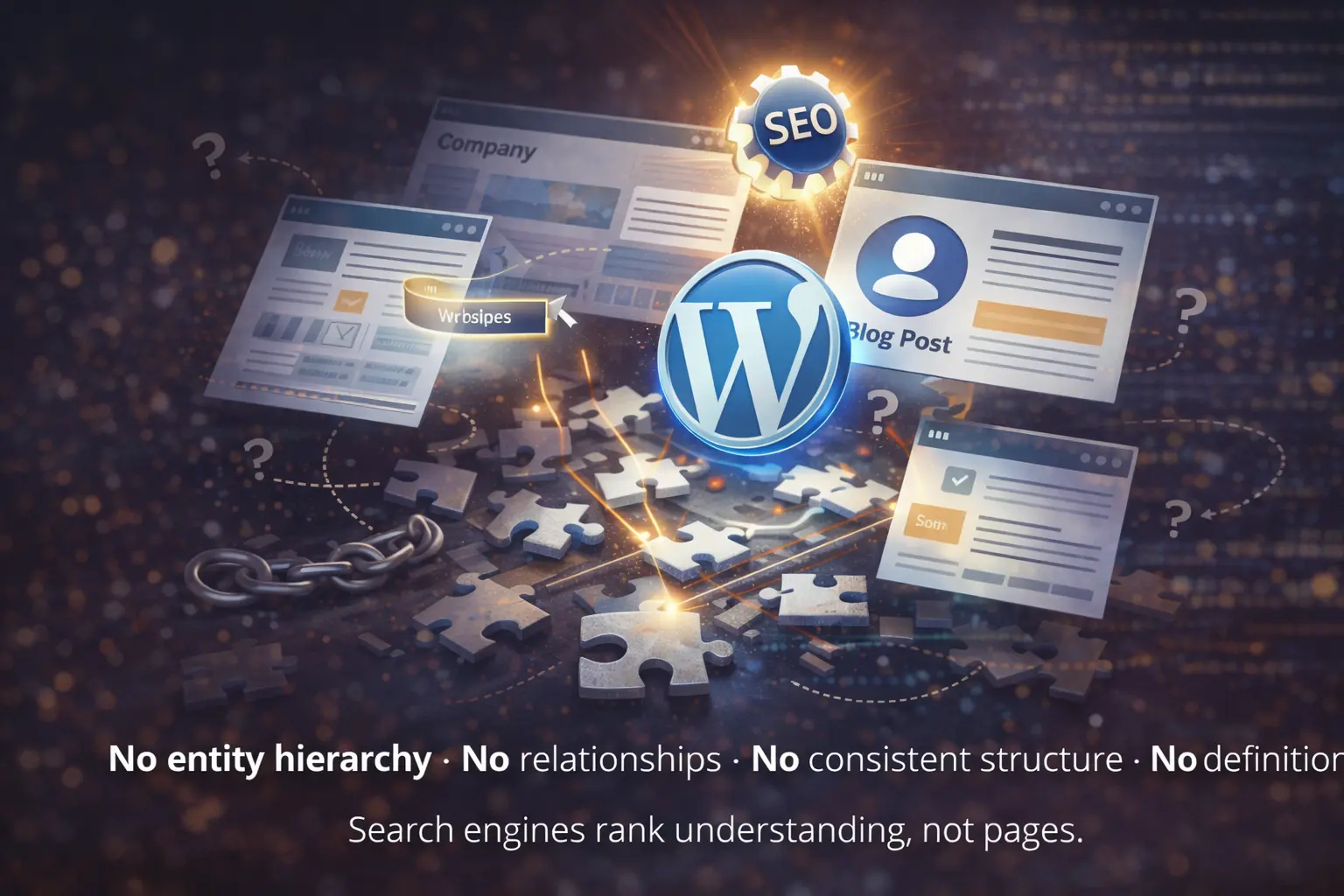
- No entity hierarchy
- No relationships between pages
- No consistent structure across all content
- There is no clear business definition
This creates a fragmented system.
Search engines do not rank pages—they rank understanding.
And without structure, there is no understanding.
Introducing: EntitySchema Pro
EntitySchema Pro is designed to turn your WordPress website into a structured, machine-readable system.
Instead of relying on generic automation, it allows you to precisely define what your website represents—and how everything is connected.
With it, you can:
- Define your core entity (business, brand, organisation)
- Control schema globally and at the page level
- Connect pages into a single structured system
- Give search engines and AI clear context
This creates a stronger and more consistent signal across your entire website.
Your website is no longer just a collection of pages—it is a structured entity.
And that change is exactly what modern SEO requires.
What EntitySchema Pro actually helps you achieve
EntitySchema Pro is not just another SEO plugin—it is a structural layer for your entire website.
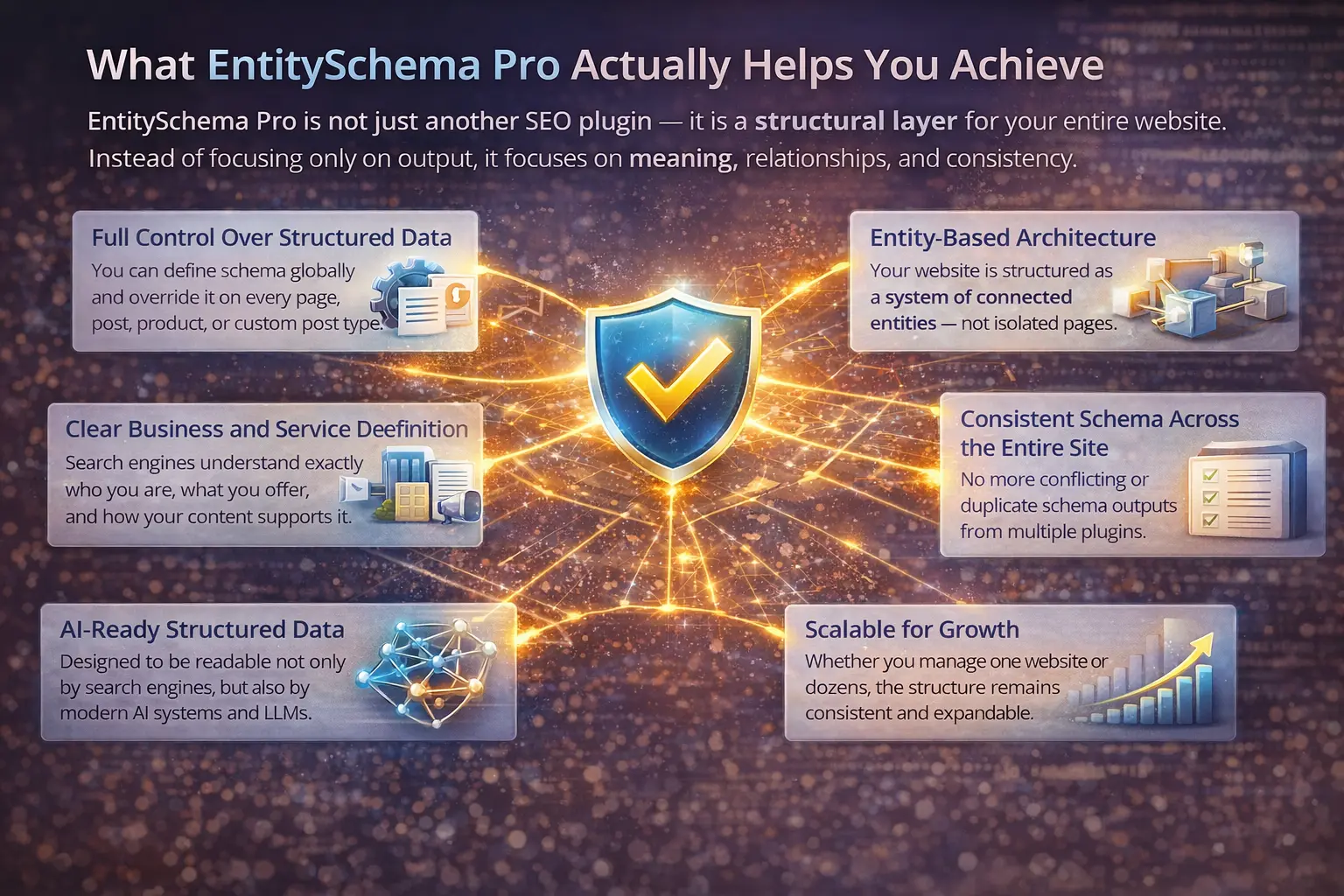
It focuses not only on output, but also on meaning, relationships and consistency.
What this means in practice:
Complete control over structured data
You can define schema globally and modify it on every page, post, product or custom post type.
Entity-based architecture
Your website is built as a system of interconnected entities—not as separate pages.
Clear definition of your business and services
Search engines understand exactly who you are, what you offer and how your content supports it.
Consistent schema across your entire website
No conflicts or duplication between different plugins.
AI-ready structured data
Built to be understood by both search engines and modern AI systems and LLMs.
Scalable for growth
Whether you have one website or dozens, the structure remains consistent and expandable.
Advanced use cases
Entity-based structured data is not limited to a single type of website.
It scales across different use cases:
Agency websites
Define services, link them to case studies and build authority through structured relationships.
Online stores
Bring products, categories and brand information together into a unified system that search engines can clearly understand.
Local businesses
Provide accurate information about your business, services and geographical context.
Content pages
Structure topics, authors and articles into a semantic network.
The more complex your website becomes, the more important structure becomes.
Who it is for (and who it is not for)
This plugin is designed for people who want more than superficial SEO.
Ideal for:
- SEO specialists who want complete control
- Agencies managing multiple websites
- For WordPress developers building structured systems
- For service-based businesses
- For WooCommerce online stores
- For content-heavy websites
Not a good fit for:
- Users looking for “install-and-forget” SEO
- Websites where structure is not important
If you are interested in how your website is understood—not just how it looks—this is where it becomes important.
How it works
The workflow is designed to be simple—yet powerful.
- Step 1: Define your primary entity (business, brand, organisation)
- Step 2: Set the global schema structure
- Step 3: Customize the schema at page level
- Step 4: Publish and keep structured data consistent
No unnecessary complexity. Just clear, structured output.
Frequently Asked Questions
What is schema markup in SEO?
Schema markup is structured data that helps search engines understand the meaning of your content.
Does WordPress add schema automatically?
Yes, but usually only at a very general level, without depth or customization.
Is schema still important in 2026?
Yes — more than ever. It is critical for both SEO and AI understanding.
What is entity SEO?
Entity SEO focuses on defining real-world objects and connecting them to one another.
Does structured data improve rankings?
Indirectly, yes. It improves understanding, which can lead to better visibility.
How does this plugin differ from others?
Most plugins automate schema. EntitySchema Pro gives you control and structure.
Does every page need schema?
Definitely on important pages — especially for services and products.
Is this plugin suitable for beginners?
Yes — but it is designed for those who want more control and more in-depth SEO.
The most common schema SEO mistakes
Even websites that use structured data often make critical mistakes.
- Too many schema types without a logical structure
- Using the wrong schema on pages
- Duplicate or conflicting data
- Ignoring entity relationships
- Complete reliance on automation
These mistakes reduce clarity and create confusion for search engines.
Poor schema is often worse than having no schema at all.
The goal is not more markup — but better structure.

Are you ready to turn your website into a structured SEO system?
SEO is no longer simply about publishing more content.
This means that your content needs to be understandable.
If your website lacks structure, it also lacks clarity — and clarity is exactly what search engines value.
EntitySchema Pro gives you that clarity.
Related Articles
Troubleshooting Common AI Assistant Issues in WordPress & WooCommerce

WordPress Schema Markup Guide – Organization, LocalBusiness, Product, FAQ & Breadcrumbs

SEO Titles and Meta Descriptions for WordPress Pages – Snippets, CTR & Keywords

Ecommerce SEO for WooCommerce – Product Pages, Categories, Schema & Images

WordPress Internal Linking Strategy – Topic Clusters, Service Pages & Blog SEO

WordPress Core Web Vitals Guide – Fix LCP, INP, CLS & Mobile Speed Issues

How to Optimize a WordPress Service Page for SEO – Structure, Keywords, FAQs & CTA